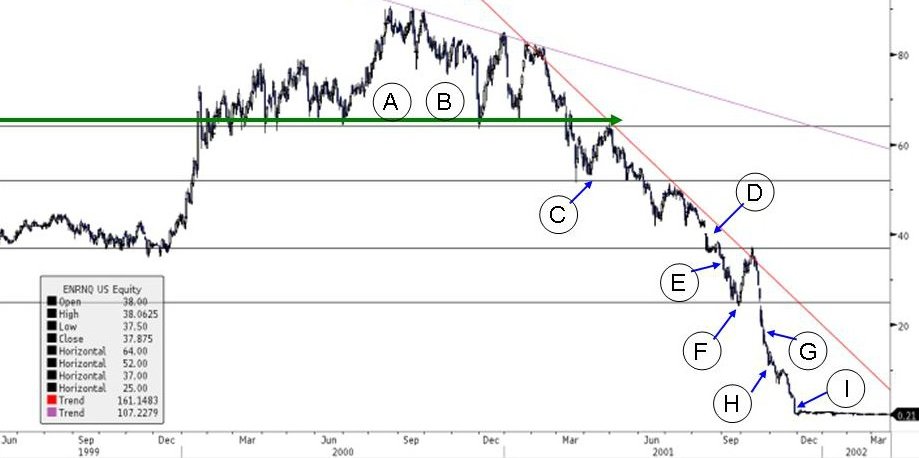
In the year 2000, Enron Corporation was the seventh largest company in the United States. It employed approximately 29,000 people. Its stock traded at over $90 a share. Fortune magazine had named it “America’s Most Innovative Company” for six consecutive years, from 1996 to 2001.
Fourteen months later, it was bankrupt. Its stock was worth pennies. Roughly 20,000 employees had lost their jobs. Thousands of ordinary workers had watched retirement savings — invested heavily in Enron stock at the company’s encouragement — evaporate to nothing.
And the men at the top had known it was coming for years.
This is the story of how Enron built the biggest corporate fraud in American history to that point, how they hid it, who paid the price, and who didn’t.
What Enron Actually Was
Enron began its life in 1985 as a natural gas pipeline company, formed from the merger of Houston Natural Gas and InterNorth — engineered with the involvement of corporate raider Irwin Jacobs, who had built a position in InterNorth stock. Kenneth Lay, formerly CEO of Houston Natural Gas, became CEO of the merged company. In those early years, Enron was exactly what it appeared to be: a company that moved natural gas through approximately 37,000 miles of pipeline and made money doing it.
The company’s name was chosen via an employee contest after an initial choice — “Enteron” — was discovered to be a medical term for intestine.
The transformation began with Jeffrey Skilling.
Skilling, a Harvard MBA who had worked as a management consultant at McKinsey & Company specifically advising Enron, joined the company in 1990 as head of Enron Finance Corp. He brought with him a radical idea borrowed from his consulting work: transform Enron from a company that owned physical assets — pipelines, power plants — into something more like a financial trading firm. A market maker for energy.
His core innovation was the “asset-light” model. Rather than primarily owning and operating energy infrastructure, Enron would trade contracts for energy delivery, create markets where none had existed, and act as an intermediary between buyers and sellers — much as an investment bank trades financial instruments rather than owning the underlying companies.
Under Skilling’s influence — he became President and Chief Operating Officer in 1996, then CEO in February 2001 — Enron expanded aggressively into electricity trading, broadband capacity trading, water utilities (through its Azurix subsidiary), and weather derivatives. It pursued international projects including the Dabhol Power Plant in India and operations in South America and the United Kingdom.
A significant portion of this expansion did not generate the profits Enron reported. The mechanism that allowed Enron to report profits anyway is the core of the fraud.
The Fraud: Mark-to-Market Accounting
The foundational tool of Enron’s deception was an accounting method called mark-to-market, which Enron received explicit approval to use for its energy trading contracts from the Securities and Exchange Commission in January 1992 — a regulatory decision that, in retrospect, enabled everything that followed.
How Legitimate Mark-to-Market Works
In standard mark-to-market accounting — used routinely by banks and trading firms for financial instruments with active, liquid markets — an asset’s value on a company’s books is adjusted to reflect its current market price, rather than its original purchase price (historical cost).
For a stock or bond traded on a liquid exchange, this is straightforward: the market price is observable and objective.
How Enron Applied It
Enron applied mark-to-market accounting to long-term energy supply contracts — agreements to deliver natural gas or electricity over periods extending to 10, 15, even 20 years — for which no liquid market existed to provide an objective price.
This meant Enron itself estimated the future value of these contracts, using internal models with assumptions about future energy prices, market conditions, and counterparty performance over periods of a decade or more. When a contract was signed, Enron could immediately book the entire estimated lifetime profit of that contract as current-period revenue — regardless of whether any cash had changed hands and regardless of whether the underlying assumptions would prove accurate.
The internal term for this practice, reportedly used informally within Enron, was “HFV” — hypothetical future value, sometimes mockingly expanded by employees as “hypothetical future value” precisely because of how speculative the underlying estimates were.
If a contract’s actual performance later fell short of the booked estimate — which happened repeatedly as energy markets moved against Enron’s positions — the resulting losses needed to be hidden, deferred, or offloaded. This created the need for the second pillar of the fraud.
The Special Purpose Entities
To hide losses and debt that mark-to-market accounting alone could not conceal, Enron’s Chief Financial Officer Andrew Fastow constructed a network of off-balance-sheet entities known as Special Purpose Entities (SPEs).
SPEs are a legitimate and common financial tool — used, for example, to isolate the risk of a specific project or securitize assets like mortgages. Under accounting rules at the time, an SPE could be kept off a parent company’s consolidated balance sheet provided that outside investors held at least 3% of the SPE’s equity and bore meaningful economic risk.
Fastow’s SPEs — with names including LJM Cayman LP, LJM2 Co-Investment LP, Chewco Investments, and the “Raptor” vehicles (Raptor I through IV) — were structured to technically satisfy this 3% threshold while, in substance, remaining under Enron’s effective control and bearing risks that ultimately fell back on Enron.
The mechanism in simplified form: when an Enron investment lost value — for example, its stake in a fiber-optic venture or a foreign power project — Enron would transfer that asset to one of Fastow’s SPEs at a price reflecting its original (inflated) book value rather than its actual diminished value. The SPE would “pay” for the asset using funds that, through various structures, ultimately originated from Enron itself — often via Enron stock or Enron-guaranteed obligations. The loss disappeared from Enron’s consolidated financial statements. Enron’s reported earnings remained smooth and growing.
Fastow personally profited from these structures to an extraordinary degree. He and associates received fees, management payments, and investment returns from the LJM partnerships that — according to the subsequent Powers Committee investigation (an internal investigation commissioned by Enron’s own board, led by University of Texas law dean William Powers) — totaled in excess of $30 million for Fastow personally, while he simultaneously served as Enron’s CFO and negotiated transactions on Enron’s behalf with entities he personally controlled. This represented a direct and severe conflict of interest that Enron’s board had formally — if inadequately — waived.
Senior executives including Skilling and Chairman Kenneth Lay either knew the substance of these arrangements or were in positions where their lack of knowledge would itself constitute a serious failure of oversight. The Powers Committee report concluded that the Enron board’s oversight of these transactions was “fundamentally flawed.”
The Culture That Enabled It
“Rank and Yank”
Enron employed an internal performance evaluation system formally called the Performance Review Committee process, known internally — and in subsequent reporting — as “rank and yank.” Twice yearly, employees across the company were ranked on a curve from 1 to 5. Those ranked in the bottom tier — typically around 15% — faced termination or reassignment, regardless of their absolute performance.
The system, championed by Skilling as a mechanism for maintaining a culture of high performers, created powerful incentives against transparency. An employee whose project was underperforming had strong career incentives to obscure that fact rather than disclose it, since disclosure of a “failing” project reflected on the employee’s own ranking.
The Analysts and the Banks
Enron’s fraud depended on — or was enabled by — the cooperation, willful blindness, or failure of due diligence of numerous external parties:
Wall Street analysts: As late as October 2001 — weeks before Enron’s collapse became public — the majority of analysts covering Enron maintained “buy” or “strong buy” ratings. Enron was known within the analyst community as a company that aggressively punished critical coverage; analysts who raised concerns reported being frozen out of access to management.
Investment banks: Citigroup and J.P. Morgan Chase were both later found by the SEC to have structured transactions — described internally at the banks using terms like “prepay” transactions — that were economically equivalent to loans but were structured and accounted for by Enron as trading activity, allowing Enron to keep the resulting debt off its balance sheet. Both banks paid substantial settlements (Citigroup and J.P. Morgan each paid $80 million to the SEC in 2003 related to these transactions, part of larger settlements addressing multiple matters) without admitting or denying wrongdoing in those specific settlements.
Arthur Andersen: Enron’s outside auditor, one of the “Big Five” accounting firms at the time, issued unqualified (“clean”) audit opinions on Enron’s financial statements for years, including for the 2000 fiscal year — statements that the Powers Committee and subsequent investigations found to be materially misleading. When the scandal broke, Andersen employees in the firm’s Houston office, working under partner David Duncan, shredded a substantial volume of Enron-related documents in late 2001, after Andersen’s own in-house counsel had indicated an SEC investigation was likely.
Arthur Andersen was indicted on a federal obstruction of justice charge in March 2002 and convicted by a jury in June 2002. The firm surrendered its CPA licenses and ceased operating as an accounting practice, resulting in the loss of approximately 85,000 jobs worldwide — the vast majority of whom had no connection to the Enron engagement. In a significant postscript, the U.S. Supreme Court unanimously overturned Andersen’s conviction in 2005 (Arthur Andersen LLP v. United States), finding that the jury instructions had been improperly broad regarding the intent required for obstruction. By the time of the reversal, Andersen as a firm no longer existed in any meaningful operational sense.
The Whistleblower
In August 2001 — with Enron’s stock already declining significantly from its 2000 highs — Sherron Watkins, an Enron Vice President of Corporate Development, wrote a memo to Kenneth Lay.
The memo, later made public during congressional investigations, ran approximately seven pages and laid out in specific detail how the Raptor entities and related transactions were structured to hide losses, and warned that the company faced the risk of what she described as potentially “implod[ing] in a wave of accounting scandals.”
Watkins had raised her concerns initially with Enron’s accounting staff and, according to her later congressional testimony, met with Lay directly on August 22, 2001. Lay commissioned a review of the issues — conducted by the law firm Vinson & Elkins, which had itself provided legal advice on structuring some of the transactions in question and was therefore not independent in any meaningful sense. The review, completed in October 2001, concluded that while the situation was “not “good,” it did not warrant a broader investigation.
Watkins was not terminated but her concerns were not acted upon with the urgency the situation required. She testified before both the House and Senate in 2002 and was named one of Time magazine’s three “Persons of the Year” for 2002, alongside fellow whistleblowers Cynthia Cooper (WorldCom) and Coleen Rowley (FBI).
The Collapse: A Timeline
October 16, 2001: Enron announced a third-quarter loss of $618 million and disclosed a $1.2 billion reduction in shareholder equity — the first public acknowledgment of the scale of the off-balance-sheet problems.
October 22, 2001: The SEC opened a formal inquiry into Enron’s related-party transactions.
November 8, 2001: Enron filed a restatement of its financial results for the years 1997 through 2000, reducing previously reported net income by a cumulative $586 million and increasing reported debt by approximately $2.6 billion through the consolidation of previously off-balance-sheet entities.
November 9, 2001: Rival energy company Dynegy announced a proposed merger with Enron, structured partly as a rescue.
November 28, 2001: Dynegy terminated the merger agreement after further deterioration in Enron’s financial position became apparent, including the discovery of additional undisclosed obligations. Credit rating agencies downgraded Enron’s debt to below investment grade (“junk”) status on the same day — a downgrade that triggered repayment obligations on billions of dollars of debt that Enron could not meet.
December 2, 2001: Enron filed for Chapter 11 bankruptcy protection in the Southern District of New York. At the time, it was the largest corporate bankruptcy in U.S. history — a record subsequently surpassed by WorldCom (2002) and later by Lehman Brothers (2008) and Washington Mutual (2008).
Approximately 4,000 Enron employees were laid off within days of the bankruptcy filing in Houston alone, with total job losses across the company reaching approximately 20,000 as operations wound down.
The Human Cost
Enron operated a 401(k) retirement plan in which the company match was provided in the form of Enron stock, and many employees, encouraged by management messaging about the company’s prospects, voluntarily held a substantial portion of their own contributions in Enron stock as well. Estimates presented in subsequent litigation indicated that Enron stock represented, on average, more than 60% of the assets in employee 401(k) accounts at the time of the collapse.
A particularly damaging element was a “lockdown” period in late October 2001, during which Enron changed its 401(k) plan administrator. During this transition — which lasted approximately three weeks, from roughly October 26 to November 13, 2001 — employees were unable to sell or reallocate their 401(k) holdings, including Enron stock, even as the stock price collapsed from approximately $15 to under $9 during that window and continued falling afterward.
Meanwhile, Kenneth Lay sold Enron stock worth approximately $70 million between 1999 and 2001, according to figures presented in subsequent litigation and congressional testimony, while continuing to publicly and internally encourage employees to view Enron stock as a sound long-term investment — including in an internal online forum post in September 2001, after the problems were known internally, in which Lay expressed confidence in the company’s prospects.
Jeffrey Skilling sold Enron stock worth approximately $60 million in the period before the collapse, though the precise figures and characterization of these sales were contested at trial.
A class-action lawsuit brought by Enron employees regarding the 401(k) losses, Tittle v. Enron Corp., resulted in a settlement in 2008 of approximately $37.5 million for the affected employee retirement plan participants — funds that came primarily from insurance proceeds and settlements with other defendants, since Enron itself had no assets remaining.
The Trials
Jeffrey Skilling
Skilling was indicted in February 2004 on charges including securities fraud, wire fraud, conspiracy, insider trading, and making false statements to auditors. His trial — conducted jointly with Kenneth Lay — began in January 2006 in Houston.
On May 25, 2006, a jury convicted Skilling on 19 of 28 counts, including conspiracy, securities fraud, and insider trading; he was acquitted on the remaining counts, including some related to insider trading on specific dates.
He was initially sentenced in October 2006 to 24 years and 4 months in prison — at the time one of the longest sentences ever imposed in a white-collar fraud case — and ordered to forfeit $45 million.
Skilling appealed, and in 2010 the U.S. Supreme Court, in a related case (Skilling v. United States), narrowed the legal theory of “honest services fraud” used in part of his conviction, though it upheld the bulk of his conviction on other grounds. Following further appellate proceedings, his sentence was reduced — first to 14 years in a 2013 agreement with prosecutors that also resolved the forfeiture amount, requiring Skilling to direct $42 million toward victims. He was released from federal custody in February 2019 after serving approximately 12 years.
Kenneth Lay
Lay was convicted on all six counts against him on the same day as Skilling — May 25, 2006 — including conspiracy and securities fraud, and was separately convicted on four additional counts of bank fraud and making false statements in a related bench trial decided by the judge.
Lay died of a heart attack on July 5, 2006, at his vacation home in Aspen, Colorado — approximately six weeks after his conviction and before his scheduled sentencing.
Under the legal doctrine of abatement ab initio (“abatement from the beginning”), which holds that a defendant’s death before the exhaustion of appeals voids the conviction as though it never occurred, the presiding judge, Sim Lake, formally vacated Lay’s conviction in October 2006. Lay’s estate also successfully petitioned to have a related civil forfeiture judgment vacated. Lay therefore died — and remains, in the formal legal record — without a criminal conviction, a outcome that has been cited frequently in legal scholarship discussing the abatement doctrine.
Andrew Fastow
Fastow was indicted on 98 counts in 2003. He pleaded guilty in January 2004 to two counts of conspiracy as part of a cooperation agreement with prosecutors, under which he agreed to testify against Skilling and Lay and to forfeit approximately $23.8 million in assets.
He was sentenced in 2006 to six years in federal prison (reduced from a plea-agreement range that had contemplated up to ten years, in recognition of his cooperation) and served his term, being released in 2011. Fastow has since spoken publicly, including at business schools and in documentary interviews, about the mechanics of the fraud and his role in it.
His wife, Lea Fastow, who had served as an assistant treasurer at Enron, pleaded guilty to a misdemeanor tax charge related to the couple’s finances and served one year in federal prison.
The Legislative Aftermath: Sarbanes-Oxley
The Sarbanes-Oxley Act of 2002 (officially the Public Company Accounting Reform and Investor Protection Act), signed into law on July 30, 2002, was enacted directly in response to Enron and the contemporaneous WorldCom accounting scandal, which became public in mid-2002 while Sarbanes-Oxley was still being drafted — significantly accelerating its passage.
Key provisions directly traceable to Enron-specific failures include:
Section 302 requires the CEO and CFO of a public company to personally certify, under penalty of criminal prosecution, the accuracy of financial statements filed with the SEC — directly addressing the plausible-deniability posture senior Enron executives had maintained.
Section 404 requires management to assess and report on the effectiveness of internal controls over financial reporting, and requires the company’s external auditor to attest to that assessment — addressing the internal control failures that allowed the SPE structures to exist undetected.
Title VIII (Section 802) establishes criminal penalties, including up to 20 years imprisonment, for the destruction or alteration of documents with intent to obstruct an investigation — a direct response to the Arthur Andersen document shredding.
Section 301 mandates that audit committees be composed entirely of independent directors and grants the audit committee direct authority over the external auditor relationship, removing that authority from management — addressing the conflicts of interest that allowed Andersen’s independence to be compromised.
The Act also created the Public Company Accounting Oversight Board (PCAOB), a private-sector nonprofit with regulatory authority to oversee the audits of public companies, replacing the prior system of self-regulation by the accounting profession.
The Legacy
Enron’s collapse remains a foundational case study in business school curricula, securities law, and corporate governance — not primarily because the fraud was technically novel, but because of its scale, the breadth of institutional failure it revealed (board oversight, external audit, credit rating agencies, sell-side analysts, and regulators all failed simultaneously and for years), and the human cost borne disproportionately by employees who had no role in and no knowledge of the fraud.
The “Enron” name became, for a period, shorthand in financial journalism for any instance of accounting that technically complied with applicable rules while substantively misrepresenting a company’s financial condition — a usage that persists in more limited form today.
The question the case continues to raise — whether the regulatory and institutional reforms enacted in its wake (principally Sarbanes-Oxley) have proven sufficient to prevent comparable failures, given subsequent crises including the 2008 financial crisis — remains a live subject of debate among economists, regulators, and legal scholars.
Key Facts
- Founded: 1985 (merger of Houston Natural Gas and InterNorth)
- Peak market capitalization: Approximately $68 billion (August 2000)
- SEC approval of mark-to-market accounting: January 1992
- Restatement (Nov 8, 2001): Reduced 1997-2000 net income by $586 million; increased debt by ~$2.6 billion
- Bankruptcy filed: December 2, 2001 (largest in U.S. history at the time)
- Jobs lost: Approximately 20,000
- Arthur Andersen jobs lost: Approximately 85,000 (firm-wide, global)
- Skilling conviction: 19 of 28 counts; sentence reduced from 24+ years to 14 years; released 2019
- Lay conviction: All counts; vacated posthumously under abatement ab initio (died July 2006)
- Fastow: Pleaded guilty; served 6 years; released 2011
- 401(k) settlement (2008): ~$37.5 million (Tittle v. Enron Corp.)
- Legislative response: Sarbanes-Oxley Act, signed July 30, 2002
Sources & Further Reading
- McLean, Bethany and Elkind, Peter. The Smartest Guys in the Room: The Amazing Rise and Scandalous Fall of Enron (2003) — the foundational journalistic account, by the Fortune reporter (McLean) whose 2001 article “Is Enron Overpriced?” was among the first mainstream challenges to the company
- Powers, William C. (chair). Report of Investigation by the Special Investigative Committee of the Board of Directors of Enron Corp. (the “Powers Report”), February 2002 — Enron’s own board-commissioned investigation
- U.S. Securities and Exchange Commission litigation releases — SEC v. Andrew S. Fastow, SEC v. Jeffrey K. Skilling, SEC v. Kenneth L. Lay, and related actions against Citigroup and J.P. Morgan Chase (2003)
- Skilling v. United States, 561 U.S. 358 (2010) — Supreme Court decision narrowing “honest services” fraud
- Arthur Andersen LLP v. United States, 544 U.S. 696 (2005) — Supreme Court decision overturning Andersen’s obstruction conviction
- U.S. Senate Permanent Subcommittee on Investigations. The Role of the Board of Directors in Enron’s Collapse (2002)
- Watkins, Sherron — testimony before the House Energy and Commerce Committee and Senate Commerce Committee, February 2002
- Tittle v. Enron Corp., settlement documentation (2008), U.S. District Court, Southern District of Texas
- Gibney, Alex (dir.). Enron: The Smartest Guys in the Room (2005) — documentary adaptation, includes interview footage with key participants
- Eichenwald, Kurt. Conspiracy of Fools: A True Story (2005) — detailed account based on extensive access to participants
Enron’s collapse rewrote the rules of American corporate accountability — and the question of whether those rules were enough remains open. Watch our full breakdown on the GrimChronicleShow YouTube channel.