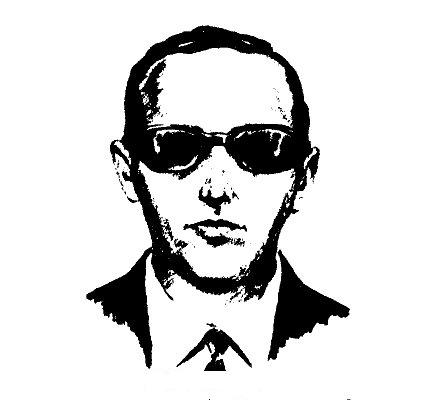
On November 24, 1971 — the day before Thanksgiving — a man calling himself “Dan Cooper” bought a one-way ticket from Portland to Seattle. He paid cash. He boarded a Boeing 727. He ordered a bourbon and soda. And somewhere over the dense forests of southwest Washington State, in the middle of a rainstorm, wearing a business suit and a parachute, he stepped out of the back of the airplane at roughly 10,000 feet — and vanished completely.
He was never identified. He was never caught. Most of the $200,000 he extorted has never been recovered.
It remains, to this day, the only unsolved act of air piracy in United States history.
The Flight
The aircraft was Northwest Orient Airlines Flight 305, a Boeing 727-100 (registration N467US) on a short hop from Portland International Airport to Seattle-Tacoma International Airport — scheduled flight time of just over 30 minutes.
The man who boarded used the name “Dan Cooper.” He paid $20 in cash for the one-way ticket and checked no luggage, carrying only a briefcase. He was described by the flight crew and passengers as a white male in his mid-40s, approximately 5'10" to 6'0", roughly 170-180 pounds, with dark hair, wearing a black raincoat, a dark business suit, a white shirt, a black tie with a mother-of-pearl tie clip, and sunglasses. He took seat 18C, in the rear of the cabin.
A note attached to a much later wire service report — the source of the now-famous “D.B. Cooper” name — actually referred to a different man entirely. A Portland-area resident named D.B. Cooper had been briefly questioned by the FBI as a routine matter in the hours after the hijacking and was quickly cleared, but a reporter relaying information from a source confused the names, and “D.B. Cooper” stuck in the press permanently. The hijacker’s actual alias, as written on the ticket and as he identified himself, was Dan Cooper.
The Note
Shortly after takeoff, Cooper passed a note to flight attendant Florence Schaffner, who initially assumed it was a phone number from a passenger and put it in her pocket unread. Cooper leaned over and quietly told her to read it.
The note stated that he had a bomb in his briefcase and instructed Schaffner to sit next to him. When she complied, Cooper opened the briefcase briefly to show her its contents: a tangle of wires and what appeared to be eight cylindrical reddish sticks, arranged in a way consistent with dynamite, attached to a large battery.
His demands, communicated verbally and in further notes:
- $200,000 in negotiable American currency — specified later as $20 bills
- Four parachutes — two primary (back) parachutes and two reserve (chest) parachutes
- The plane was to land in Seattle, where the demands would be met, after which passengers would be released
Seattle: The Exchange
Captain William Scott radioed the hijacking demands to Northwest Orient’s headquarters and to the FBI, which began assembling the ransom while the plane circled Puget Sound for nearly two hours — both to give authorities time to gather the money and parachutes, and because Cooper insisted the plane not land until everything was ready.
Northwest Orient’s president personally authorized the payment. The $200,000 was assembled from a Seattle bank — 10,000 individual $20 bills, all with serial numbers beginning with the letter “L,” recorded on microfilm by the bank before being handed over. This microfilm record would later become the single most important piece of physical evidence in the entire case.
The parachutes were sourced from a local skydiving school, Issaquah Sky Sports. Cooper would later reject one of the reserve chutes provided — a request that has fueled decades of speculation about his level of parachuting expertise, discussed further below.
The plane landed at Sea-Tac just after 5:30 PM. Cooper allowed all 36 passengers and flight attendant Alice Hancock to disembark in exchange for the money and parachutes, which were delivered to the aircraft via a Northwest Orient employee. The crew — Captain Scott, First Officer William Rataczak, Flight Engineer Harold Anderson, and flight attendant Tina Mucklow — remained aboard.
The Jump
With the ransom and parachutes aboard, Cooper directed the crew on a specific flight plan: depart toward Mexico City, with a refueling stop, flying at a maximum altitude of 10,000 feet, airspeed below 200 knots, flaps set at 15 degrees, landing gear down, and the cabin unpressurized — all configurations consistent with someone planning to safely open the aircraft’s rear exit in flight, which would be impossible at normal cruising altitude and pressurization.
He also specified the rear airstair — the built-in staircase unique to the 727’s tail design, which could be lowered in flight — be left available for his use.
The plane departed Seattle at approximately 7:40 PM, climbing slowly into a cold, rainy, nearly moonless night. Cooper ordered Tina Mucklow to the cockpit and remained alone in the passenger cabin.
At approximately 8:00 PM, the crew, monitoring instruments from the cockpit, noted the rear airstair being lowered — indicated by a warning light and a change in the aircraft’s trim that required the pilots to adjust controls to compensate.
At approximately 8:13 PM, the aircraft registered a sudden pressure bump and a noticeable change in trim — consistent with a person (and the weight of the money) departing the aircraft via the rear stairs.
When the plane landed in Reno, Nevada, just before 11 PM, Cooper, the money, two parachutes, his necktie, and the mother-of-pearl tie clip were gone. He had left behind the second set of parachutes (the ones he hadn’t used), his clip-on tie, the tie clip, and eight cigarette butts — Raleigh brand — in the ashtray of seat 18E.
He was never seen again.
The Search
The FBI, in cooperation with the U.S. Air Force, Army, and local law enforcement, launched what became known internally as NORJAK (“Northwest Hijacking”) — one of the longest-running investigations in FBI history.
Based on the aircraft’s speed, heading, and the timing of the pressure bump, investigators calculated a probable drop zone in a rugged, heavily forested area of southwest Washington, generally north of the town of Woodland and east of the Lewis River — an area that includes parts of what is now the Gifford Pinchot National Forest.
Ground and air searches involving hundreds of military personnel, FBI agents, and local volunteers began within days and continued, in various forms, for years. No trace of Cooper, his parachute, his clothing, or the bulk of the money was found in the immediate search area — despite the area being searched repeatedly, including with the aid of National Guard troops, throughout the 1970s.
The weather that night was a critical factor cited by almost every analysis of the case: temperatures at altitude were estimated around -7°C (about 19°F), with the ground temperature near freezing and heavy rain. Cooper jumped wearing a business suit, a thin raincoat, and loafers — no special cold-weather or impact gear beyond the parachute itself. Virtually every survival expert who has examined the case has concluded that, even if Cooper’s parachute deployed successfully and he landed without serious injury, his chances of surviving exposure overnight in that terrain and those conditions were extremely low.
This has not stopped the case from being framed, popularly, as an open question of whether Cooper survived — a framing the available evidence does not strongly support, but which the absence of a body has never definitively closed.
The Parachute Question
One detail has occupied parachuting experts for decades: of the four parachutes provided, Cooper selected a civilian sport parachute with a manually-operated ripcord for his main, but for his reserve, he was given — and accepted — a non-functional reserve chute that had been sewn shut for use as a training/display aid, which was among the parachutes provided by the skydiving school by mistake.
Experienced skydivers have noted that an experienced jumper would very likely have noticed this during a pre-jump inspection — chest reserves are typically checked before a jump. That Cooper either didn’t notice or didn’t check has been cited as evidence that he was not an experienced parachutist, possibly only familiar with parachutes from military training (where pre-jump gear checks are typically performed by a jumpmaster, not the jumper) rather than civilian skydiving (where self-inspection is standard).
Others note the jump itself — at night, in a storm, into unfamiliar mountainous terrain, from a commercial jet using an aft staircase never designed for parachute operations — was an extraordinarily risky undertaking regardless of experience level, and argue it’s equally consistent with a desperate amateur as a a methodical professional.
What He Left Behind
The physical evidence recovered from the aircraft became the foundation of decades of forensic work:
The necktie and tie clip: Cooper’s J.C. Penney clip-on tie and mother-of-pearl tie clip were recovered from his seat. In 2009, a team of independent forensic scientists — working under the name Citizen Sleuths, led by physicist Tom Kaye, with FBI cooperation — conducted microscopic and elemental analysis of particles embedded in the tie using scanning electron microscopy. They identified particles of titanium, as well as rare earth elements including cerium and strontium sulfide, in combinations that the team concluded were most consistent with environments involving metal manufacturing, particularly titanium fabrication — an industry concentrated, at the time, around facilities like Boeing’s Renton plant and certain specialized metallurgical and chemical operations in the Pacific Northwest. This finding has been used both to support and to undermine specific suspect theories, depending on whether a given suspect can be placed in such an environment.
The cigarette butts: Eight Raleigh-brand filtered cigarette butts were recovered. Raleigh cigarettes at the time offered a coupon redemption program printed on each pack, and were considered a relatively unusual brand choice — more commonly associated, according to some retrospective analyses, with older smokers or those who specifically valued the coupons, adding a minor data point to profiling efforts regarding Cooper’s age and habits.
Fingerprints: Partial fingerprints were recovered from the aircraft, including from a magazine Cooper had apparently handled, and have been used as a comparison point against various suspects over the decades — though degraded print quality has made many comparisons inconclusive rather than exclusionary.
The unused parachutes: The two parachutes Cooper did not take were recovered and examined but yielded no additional forensic information beyond confirming the equipment provided.
The Money Resurfaces: Tena Bar, 1980
For nearly nine years, none of the ransom money surfaced.
Then, on February 10, 1980, an eight-year-old boy named Brian Ingram, on a family outing along the Columbia River at a sandy area known as Tena Bar, near Vandalia, Washington — roughly nine miles downstream from Vancouver, Washington, and well outside the originally calculated drop zone — uncovered three disintegrating bundles of cash partially buried in the sand.
The bills were confirmed by the FBI to be part of Cooper’s ransom: $5,800 in decomposed $20 bills, with serial numbers matching the recorded list from the Seattle bank. The bills were found still loosely banded in their original rubber-banded stacks, though the rubber bands themselves had deteriorated.
This discovery has generated as much controversy as it resolved. Tena Bar is located along the Columbia River, well outside the calculated flight path and drop zone associated with the 8:13 PM jump — raising the question of how the money traveled there.
Multiple geological studies — including analysis associated with Leonard Palmer, a geology professor at Portland State University, and later independent reviews — have examined river sediment deposition patterns at Tena Bar. Findings have been genuinely mixed: some analyses concluded the bundle’s condition and burial depth were consistent with having been deposited by river dredging operations conducted by the U.S. Army Corps of Engineers in the years before 1980 — meaning the money could have entered the river anywhere upstream (including areas closer to the original drop zone) and been redeposited at Tena Bar during dredging, rather than having been carried there by Cooper himself or by natural river flow alone. Other analyses have argued the deposition pattern is also broadly consistent with the money simply having washed downstream over years via normal river action. No analysis has definitively resolved the question, and it remains one of the most actively re-examined pieces of evidence in the case, including by amateur and professional researchers using updated hydrological modeling.
The remaining $194,200 has never been found.
Major Suspects
Over the life of the investigation, the FBI examined and ruled out, fully or partially, more than a thousand individuals. A handful have remained the subject of sustained public attention.
Richard Floyd McCoy Jr.
Five months after the Cooper hijacking, in April 1972, Richard McCoy, a Vietnam veteran, former Army helicopter pilot, and Sunday school teacher from Utah, hijacked United Airlines Flight 855 in a strikingly similar manner — demanding cash and parachutes and jumping from a 727 over Utah. McCoy was identified and arrested within days, due in part to fingerprint evidence he left behind, and was convicted.
The similarities led some investigators — most prominently FBI agent Russell Calame, who had worked the original NORJAK case, and author Bernie Rhodes — to argue in the 1991 book D.B. Cooper: The Real McCoy that McCoy was also responsible for the original 1971 hijacking.
However, McCoy had a documented alibi for Thanksgiving 1971: family members and church records placed him with his family in Utah/Las Vegas over that holiday weekend. The FBI investigated the McCoy connection and did not pursue charges related to the Cooper case. McCoy escaped from federal prison in 1974 and was killed in a shootout with FBI agents in Virginia later that year, foreclosing any possibility of further questioning.
Kenneth Christiansen
Kenneth Christiansen, a former U.S. Army paratrooper and longtime Northwest Orient Airlines employee (working variously as a flight attendant, purser, and mechanic), became a focus of public attention following extensive reporting by journalist Geoffrey Gray, published in New York magazine in 2011 and expanded in his book Skyjack: The Hunt for D.B. Cooper.
Christiansen’s younger brother, Lyle Christiansen, became suspicious after Kenneth’s death from cancer in 1994, citing Kenneth’s sudden 1972 purchase of a house and land — a purchase made with cash shortly after the hijacking — despite no obvious prior savings sufficient for the purchase, as well as Kenneth’s strong resemblance to FBI sketches and his paratrooper training.
Working against the theory: witness descriptions consistently placed Cooper at 5'10" or taller, while Christiansen was reported to be approximately 5'8". The FBI examined the Christiansen lead following the New York magazine reporting but did not pursue it further.
Robert Rackstraw
Robert Rackstraw, a Vietnam-era Army helicopter pilot with training in demolitions and parachuting, and a man with an extensive subsequent criminal record (including check fraud and, in 1978, faking his own death in a staged plane crash off the California coast to evade prosecution), was investigated by the FBI as a Cooper suspect during the original 1970s-1980s investigation and was, according to later FOIA-released documents, considered a strong candidate at one point — though the FBI ultimately stated it lacked sufficient evidence to charge him.
Rackstraw was thrust back into public attention by a 2016 History Channel documentary, D.B. Cooper: Case Closed?, produced by former investigative journalist Thomas Colbert, which argued — based on analysis of letters allegedly sent by Cooper to newspapers shortly after the hijacking, claimed to contain encoded references to Rackstraw’s military unit numbers — that Rackstraw was Cooper.
The FBI publicly stated that the Colbert team’s analysis did not meet evidentiary standards, and closed the NORJAK case entirely in July 2016, a closure announcement that came shortly after the documentary aired, though the FBI stated the timing was coincidental and reflected resource reallocation rather than a response to the documentary specifically. Rackstraw denied being Cooper until his death in 2019.
Lynn Doyle “L.D.” Cooper
In 2011, a woman named Marla Cooper came forward publicly, stating that her uncle, Lynn Doyle “L.D.” Cooper, a Korean War veteran, matched the profile and that she had childhood memories from around Thanksgiving 1971 of overhearing her uncles discussing a “fool-proof” plan involving an airplane, and of L.D. returning home injured shortly afterward.
The FBI tested a guitar strap reportedly handled by L.D. Cooper for fingerprint and DNA evidence against partial prints and a DNA sample recovered from the hijacker’s tie. Initial results were reported as inconclusive — not a clear match, but not a clear exclusion either, given sample degradation. Independent researcher Eric Ulis has continued investigating the L.D. Cooper lead in subsequent years, including efforts to obtain updated DNA analysis using techniques not available in 2011.
Duane Weber
Duane Weber, a man with a criminal record including burglary, reportedly told his wife Jo Weber on his deathbed in 1995, “I’m Dan Cooper” — a statement Jo initially dismissed as confused but later took seriously enough to begin her own research, detailed in her self-published book D.B. Cooper: What Really Happened.
Jo Weber’s research found that Duane had spent time in the Pacific Northwest, had a old knee injury consistent with a hard parachute landing (by his own account from “the war,” though his military records did not clearly support this), and had once mentioned a place — “Tina” — to her in his sleep, which she connected to Tena Bar after the location became public knowledge. The FBI compared Weber’s fingerprints to those recovered from the aircraft and reported no match, though Jo Weber and supporters have questioned whether all available prints were compared.
William Gossett
William Gossett, a U.S. Army colonel with Special Forces (Green Beret) experience including extensive parachute and demolitions training, was proposed as a suspect by family members, including a great-grandson who came forward publicly in the 2010s, citing alleged family stories of a confession and Gossett’s relevant skill set. Gossett died in 2003; no physical evidence has been definitively tied to him.
Sheridan Peterson
Sheridan Peterson, a former Marine Corps parachute instructor and Boeing employee with extensive smokejumping experience, was investigated as a suspect partly due to his skill set and Boeing connection (relevant to the titanium particle findings). Peterson has stated he was overseas (in Nepal, working for a humanitarian organization) at the time of the hijacking — an alibi the FBI reportedly found credible — and has spoken about the case publicly, at times with evident amusement at his inclusion on suspect lists.
The Case Closes — Sort Of
In July 2016, the FBI formally announced it was redirecting resources away from the active investigation of the Cooper case — widely reported as the case being “closed,” though the FBI’s own statement specified that evidence would be retained and that the Bureau would continue to act on any specific, verifiable new evidence (such as a confirmed parachute or definitively-matched ransom bills) if it emerged, while no longer dedicating active investigative resources to the case.
This marked the formal end of the longest investigation in FBI history up to that point, spanning 45 years.
Independent researchers — including Eric Ulis, Tom Kaye’s Citizen Sleuths group, and others — have continued investigating, including conducting their own searches of the Columbia River and surrounding areas, and periodically claim new leads, none of which have, to date, produced verified ransom currency, a confirmed parachute, or human remains conclusively tied to the case.
Why It’s Never Been Solved
Several factors compound to make this case unusually resistant to resolution, even compared to other cold cases:
The jump occurred at night, in a storm, over dense, mountainous, and at the time largely unmapped forest — terrain that has, in the decades since, been further altered by logging operations, the 1980 eruption of Mount St. Helens (which deposited ash over a significant portion of the broader region, though not directly over the most likely drop zones), and natural decomposition processes that would leave little trace of fabric, a body, or unburied currency after five decades.
The alias was fictitious and appears to have been chosen — according to research by French comic book historians — as a reference to “Dan Cooper,” the protagonist of a popular Franco-Belgian comic book series about a Royal Canadian Air Force test pilot, published in Europe (and notably, in French-language Canadian publications) starting in the 1950s but never widely translated or distributed in the United States at the time. If accurate, this detail has been cited as a possible (though far from conclusive) indicator that the hijacker had some exposure to European or Canadian print media uncommon among American readers of the era.
And critically, the money itself was largely never recovered — without it (or definitive forensic remains), the case lacks the kind of physical anchor that has resolved many other cold cases through modern DNA techniques.
Key Facts
- Date: November 24, 1971 (Thanksgiving Eve)
- Flight: Northwest Orient Airlines Flight 305, Portland to Seattle, Boeing 727-100
- Ransom: $200,000 in 10,000 $20 bills (serial numbers recorded)
- Equipment demanded: 4 parachutes (2 main, 2 reserve)
- Jump location: Estimated over southwest Washington State, ~8:13 PM, ~10,000 ft altitude
- Evidence recovered: Clip-on tie, tie clip, 8 Raleigh cigarette butts, unused parachutes
- Money found: $5,800 at Tena Bar, Columbia River, February 10, 1980 (Brian Ingram)
- Remaining ransom: $194,200, never recovered
- FBI case status: Active investigation ended July 2016, after 45 years (NORJAK)
- Major suspects: Richard McCoy Jr., Kenneth Christiansen, Robert Rackstraw, L.D. Cooper, Duane Weber, William Gossett, Sheridan Peterson — none confirmed
Sources & Further Reading
- Gray, Geoffrey. Skyjack: The Hunt for D.B. Cooper (2011) — includes the original Kenneth Christiansen reporting
- Gray, Geoffrey. “Unmasking D.B. Cooper,” New York magazine (2011)
- Rhodes, Bernie and Calame, Russell. D.B. Cooper: The Real McCoy (1991)
- FBI NORJAK case files — released under FOIA, archived at vault.fbi.gov
- FBI press release, “D.B. Cooper Hijacking” — case status announcement, July 2016
- Citizen Sleuths (Tom Kaye et al.) — forensic tie particle analysis reports (2009-2011)
- Colbert, Thomas J. and Lansing, Tom. The Last Master Outlaw (2016) — Rackstraw theory
- Weber, Jo. D.B. Cooper: What Really Happened (self-published)
- Palmer, Leonard — geological analysis of Tena Bar money discovery, Portland State University
- Ulis, Eric — ongoing independent research, including History Channel specials and Columbia River search expeditions
Fifty-five years on, the only certainty in the D.B. Cooper case is the $194,200 still missing somewhere in the Pacific Northwest. Watch our full breakdown on the GrimChronicleShow YouTube channel.