On the night of February 1, 1959, nine experienced Soviet hikers cut their way out of their tent from the inside and fled into the darkness of a Ural mountain in temperatures approaching minus 30 degrees Celsius. They were found weeks later in states that defied easy explanation — some with catastrophic internal injuries but no external wounds, one missing her tongue, several with traces of radiation on their clothing, and all of them dead.
The Soviet investigation concluded that the group had perished due to an “unknown compelling force.”
That explanation has satisfied no one in the 67 years since.
The Dyatlov Pass incident is one of the most discussed, most debated, and most genuinely puzzling unexplained deaths in modern history. Here is everything we know — and everything we still don’t.
The Group: Nine People
The nine hikers were students, graduates, and one outside member of the Ural Polytechnical Institute (UPI) in Sverdlovsk — now Yekaterinburg. This was not a group of inexperienced amateurs. All members held at least Grade II hiking certification, and the expedition itself was rated Category III — the most difficult grade in the Soviet hiking certification system at the time.
Igor Dyatlov, 23, the group’s organizer and namesake. An electronics engineering student known for his careful planning and previous successful expeditions in the Urals. He had personally designed an improved tent stove used on previous trips.
Zinaida Kolmogorova, 22, an engineering student described by friends as warm and outgoing. She kept a personal diary during the expedition, portions of which were recovered and have been published.
Lyudmila Dubinina, 20, a construction student and the group’s most experienced female hiker, having already completed several Category III expeditions.
Alexander Kolevatov, 24, a physics student working at a secret nuclear research facility — a detail that has fueled speculation for decades, though no evidence has ever connected his employer to the deaths.
Rustem Slobodin, 23, an engineer who had recently begun working at a factory after graduating.
Yuri Doroshenko, 21, an engineering student and close friend of several other group members.
Yuri Krivonischenko, 23, a graduate engineer who had previously worked at Mayak, a Soviet nuclear facility — the same facility responsible for the 1957 Kyshtym disaster, one of the worst nuclear accidents in history before Chernobyl. This connection is the source of much of the radiation speculation surrounding the case.
Nicolas Thibeaux-Brignollel (also rendered Nikolai Thibault-Brignolles), 23, a construction engineer of French descent — his great-grandfather had emigrated to Russia from France during the Communard exile.
Semyon (Alexander) Zolotaryov, 38, the oldest member of the group by a significant margin and not originally part of the planned expedition. Zolotaryov was a ski instructor who joined the group at the last minute, reportedly to gain hours toward an instructor certification. His age, late addition to the group, and several inconsistencies in his personal history — including tattoos inconsistent with his stated biography — have made him a recurring focus of alternative theories.
A tenth member, Yuri Yudin, had originally been part of the group but turned back on January 28th due to illness — sciatica and joint pain. He was the only member of the original expedition to survive, living until 2013. He spent much of his life trying to understand what happened to his friends.
The Journey
The group departed Sverdlovsk by train on January 23, 1959, traveling to Ivdel and then to the settlement of Vizhai — the last inhabited point before the wilderness. From Vizhai, they began skiing toward Otorten, a mountain in the northern Ural range, on January 27th.
Yudin turned back on the 28th. The remaining nine continued.
The group’s photographs — recovered from cameras found at the scene and developed afterward — show a group in good spirits. They are seen building a snow shelter, skiing, laughing, and preparing meals. The last confirmed photographs were taken on the afternoon of February 1st, showing the group constructing what appears to be a platform for their tent on the slope of Kholat Syakhl.
Kholat Syakhl is a name from the indigenous Mansi language, often translated as “Dead Mountain” or “Mountain of the Dead” — though linguists have noted the translation is somewhat more literally rendered as “Holʹat-Syakhyl,” meaning roughly a mountain devoid of vegetation, and the ominous translation may be partly a product of later sensationalism. Regardless, the name predates the 1959 incident by generations and was used by local Mansi reindeer herders.
The group had intended to reach the treeline before nightfall — a standard practice for safety and warmth. Weather conditions deteriorated, visibility dropped, and the group lost their bearing slightly, ending up on the open slope of Kholat Syakhl rather than in the sheltered valley below.
Dyatlov made the decision to set up camp on the slope itself rather than descend roughly 1.5 kilometers to the treeline. This decision — while unusual — was not necessarily reckless for a group of this experience level; descending in poor visibility carried its own risks, and the group likely intended to descend the following morning.
They pitched their tent, prepared a meal, and settled in for the night.
The Search and Discovery
The group’s planned return date was February 12th. When they failed to arrive, and with no contact by the 20th, a search was organized — initially by fellow students and instructors from UPI, then escalating to include the army, police, and aviation units.
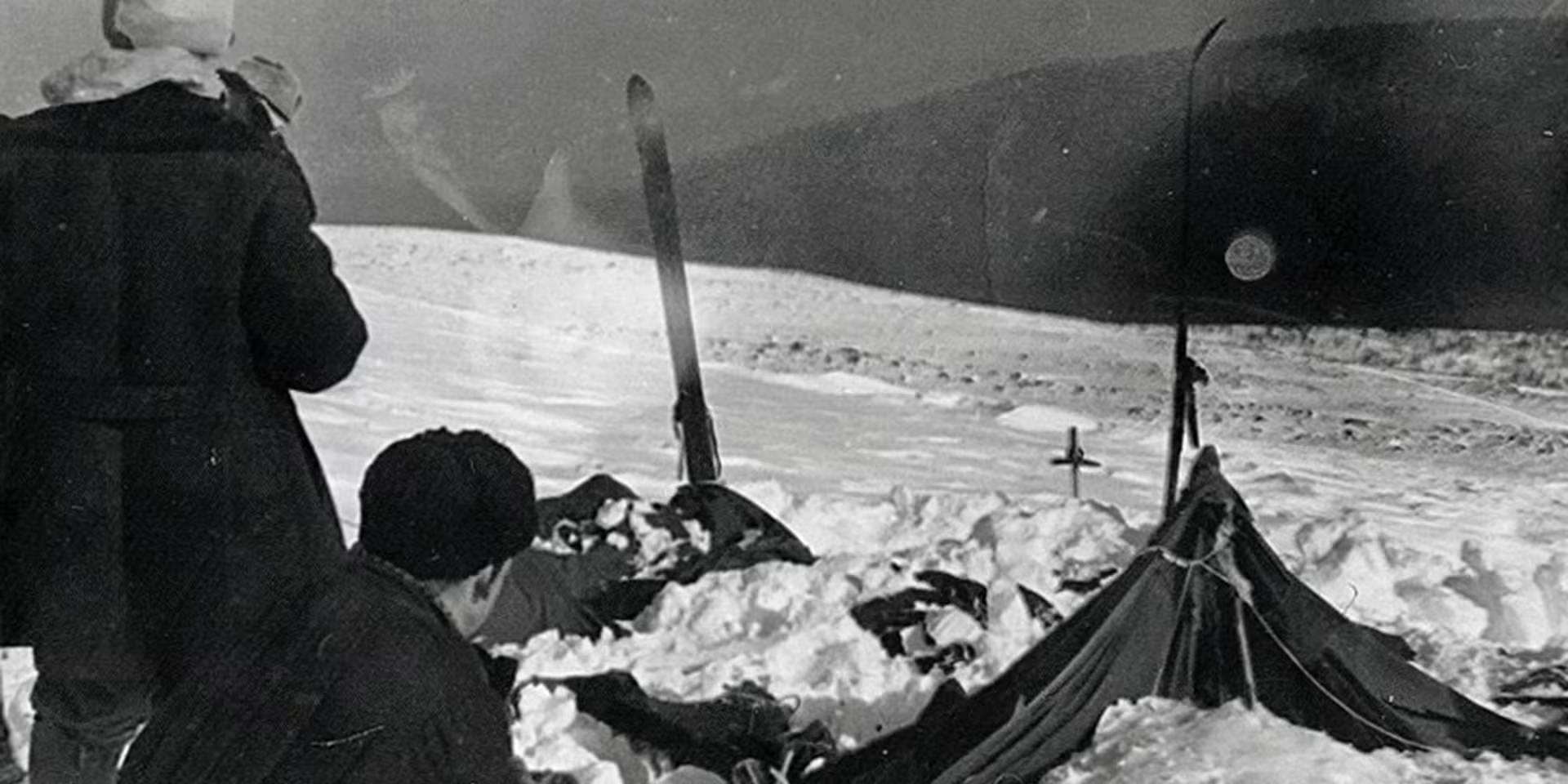
On February 26, 1959, search member Mikhail Sharavin discovered the tent on the slope of Kholat Syakhl, partially covered by snow.
The condition of the tent was the first sign that something had gone catastrophically wrong.
The tent had been cut open from the inside — not unzipped through the entrance, but sliced through the fabric wall with a knife, in at least two places. Inside, the group’s belongings were found largely intact and in order: boots, coats, food, the stove, cameras, and — significantly — Zinaida Kolmogorova’s diary.
Outside the tent, eight or nine sets of footprints — some bare, some in socks, none in proper winter footwear — led down the slope toward the treeline, approximately 1.5 kilometers away.
The group had left their shelter, in extreme cold, at night, in a hurry, without their boots or adequate outer clothing — and without, apparently, attempting to retrieve them despite the supplies being readily accessible inside the tent.
The Bodies: A Detailed Account
The nine bodies were recovered in two phases over the following months, and the condition of each body has been documented in the official autopsy reports — which were partially declassified decades later and have been the subject of intense study.
Phase One: The Cedar Tree and the Slope (Found February 26-March 5)
Yuri Doroshenko and Yuri Krivonischenko were found first, on February 26th, beneath a large cedar tree approximately 1.5 kilometers from the tent, at the edge of the treeline. Both were found in their underwear — barefoot, without hats, without adequate clothing for the conditions. The cedar’s lower branches, up to a height of approximately five meters, had been broken off — consistent with someone climbing the tree, possibly to gain visibility of the tent or to break branches for a fire. A small fire had indeed been lit at the base of the tree, but it had burned only briefly and provided minimal warmth. Both died of hypothermia. Krivonischenko’s body showed evidence of tissue damage on his hands consistent with attempts to handle fire despite numbness.
Igor Dyatlov was found on March 5th, approximately 300 meters up the slope from the cedar, in a position suggesting he had been attempting to return to the tent. He was found lying on his back, partially buried in snow, with one hand gripping a small birch branch and the other positioned near his chest as if shielding his face. He was wearing more clothing than Doroshenko and Krivonischenko but still inadequately for the conditions. Cause of death was hypothermia.
Zinaida Kolmogorova was found the same day, further up the slope toward the tent than Dyatlov, also apparently attempting to return. She was found in a crawling position, with significant abrasions on her hands and forearms consistent with crawling over rough terrain. Cause of death was hypothermia.
Rustem Slobodin was found between Dyatlov and Kolmogorova, also on March 5th. His autopsy revealed a skull fracture — a crack approximately 6cm long — that the medical examiner, Dr. Boris Vozrozhdenny, determined had not been the cause of death and had likely occurred without the victim being immediately incapacitated, possibly from a fall. He died of hypothermia. One of his feet had a sock but no boot; the other was bare.
The pattern of these five bodies — two who clearly succumbed near the tree where a fire had been attempted, and three who appeared to be attempting a return to the tent — suggested to investigators that the group had split or spread out during whatever event caused them to flee, with some members weaker or more injured than others.
Phase Two: The Ravine (Found May 4)
The remaining four bodies were not found until May 4, 1959, when melting snow revealed them in a ravine approximately 75 meters from the cedar tree, under approximately four meters of snow that had accumulated over a small stream.
These four bodies were the best-dressed of the nine — they were wearing clothing that, in some cases, had clearly been removed from the bodies of Doroshenko and Krivonischenko, who had been found nearly naked. This indicated that these four had survived long enough after the others’ deaths to strip clothing from their bodies — suggesting this group survived for a period of time, possibly hours, after the others had died.
Lyudmila Dubinina had the most severe injuries of any victim. Her autopsy documented multiple fractured ribs (the report specifies fractures to ribs on both sides), a significant hemorrhage into the right ventricle of the heart, and — most disturbingly — she was missing her tongue, eyes, part of the lips, facial tissue, and a fragment of skull bone. Dr. Vozrozhdenny’s report attributed the soft tissue loss to “the action of stream water” — decomposition and exposure to flowing water over the roughly three months between death and recovery. This explanation has been the single most contested element of the entire case. Critics note that other soft tissue (and clothing) on the same and nearby bodies was comparatively well preserved, raising questions about whether water exposure alone could account for the specific and selective nature of the missing tissue.
Semyon Zolotaryov had similarly severe chest injuries — multiple rib fractures and a fatal hemorrhage. His eyes were also missing, again attributed by the original report to decomposition.
Nicolas Thibeaux-Brignollel had a massive skull fracture — described in the autopsy as a depressed fracture of the temporal bone with no corresponding external wound or laceration of the scalp. The medical examiner noted that such an injury would typically require a force “equal to that of a car accident” but found no evidence of an external object or weapon.
Alexander Kolevatov had the least severe physical trauma of the four but showed an unusual finding: his autopsy noted a deformation in his neck musculature without clear external cause.
All four were determined to have died of injuries consistent with massive blunt force trauma, with hypothermia as a contributing factor for those who survived the initial trauma.
The Radiation Finding
Forensic-radiological testing was conducted on clothing recovered from several victims, principally Krivonischenko, Dubinina, and Zolotaryov. The results, declassified decades later, showed levels of beta-radioactive contamination “exceeding the norm” on several garments — described in the original Soviet documentation as elevated but not characterized in detail regarding specific becquerel readings in publicly available translations.
The most commonly cited explanation is mundane: Krivonischenko had worked at Mayak, the nuclear facility responsible for the 1957 Kyshtym disaster — one of the most serious nuclear accidents in history, kept secret by Soviet authorities for over 30 years. Workers and former workers from contaminated facilities could carry residual contamination on clothing for extended periods, and clothing was frequently shared, reused, or redistributed among friends and colleagues in Soviet society due to scarcity.
This explanation accounts for contamination on Krivonischenko’s own clothing reasonably well. It is somewhat less satisfying as an explanation for contamination on clothing belonging to Dubinina and Zolotaryov, who had no documented connection to nuclear facilities — though if clothing items were shared or swapped within the group (a common practice on long expeditions, and consistent with the clothing-stripping evidence found on the ravine bodies), cross-contamination becomes plausible.
No public report has definitively ruled the radiation finding in or out as significant to the deaths.
The Official Investigation
The investigation was led by Lev Ivanov, a senior investigator for the Sverdlovsk regional prosecutor’s office. Ivanov’s investigation lasted from late February to May 1959, and the resulting case file — declassified in stages, most significantly in the 1990s — runs to several hundred pages.
The investigation’s official conclusion, recorded in the closing documents dated May 28, 1959, stated that the cause of death was a “compelling natural force” (часто переводится как “stikhiynaya neodolimaya sila”) which the hikers could not overcome. No criminal charges were filed. The case was classified, and access to the full file was restricted for over three decades.
Ivanov’s Later Statements
Lev Ivanov died in 1990. In the years before his death, following the loosening of Soviet-era restrictions under glasnost, he gave interviews in which he expressed views considerably more specific — and more unusual — than his official 1959 conclusions.
In a 1990 article published in the regional newspaper Leninsky Put, Ivanov stated that he had personally observed strange luminous phenomena in the sky during the period of the investigation, and that he believed the deaths were connected to what he described, using the language available to him at the time, as “fireballs” — and stated his belief that the case had been suppressed because of a connection to undisclosed military testing in the region.
Whether Ivanov’s later statements reflect genuine investigative insight suppressed at the time, or reflect the speculative tendencies common among aging investigators reflecting on unsolved cases during a period when such speculation was newly permitted, remains a matter of interpretation. His statements are documented and verifiable as his statements — but they constitute testimony, not evidence.
Reports of Luminous Phenomena
Independent of Ivanov’s later statements, multiple weather stations and independent witnesses in the northern Urals region reported observing unusual luminous phenomena in the sky during early February 1959 — described variously as glowing orbs or unusual atmospheric lights. These reports were documented contemporaneously by Soviet meteorological services, separate from the Dyatlov investigation, and were not initially connected to the case. Soviet military rocket and missile testing was occurring in the broader region during this period, and unusual atmospheric phenomena associated with rocket launches and re-entry are a documented and mundane explanation for many such sightings — though no specific test has been definitively linked to the dates and locations relevant to the Dyatlov case.
Major Theories: Evidence For and Against
Avalanche
The case for: A 2021 study published in Communications Earth & Environment by Swiss researchers Johan Gaume and Alexander Puzrin used computational modeling, informed by automotive industry slope-stability software, to argue that a delayed slab avalanche — triggered by the cut the group made into the slope to pitch their tent, combined with specific wind-loading conditions that night — could produce the observed injury pattern. Their model suggested that a slab of snow striking sleeping bodies could produce the severe but localized chest and skull injuries seen in the ravine victims without leaving the visible debris field typically associated with larger avalanches.
The case against: The original search teams — experienced mountaineers themselves — reported no visible avalanche evidence on the slope, including no disturbed snow pack consistent with a slide. The slope angle (estimated at around 15 degrees in the area of the tent) is shallower than slopes typically associated with slab avalanches, though the Gaume-Puzrin study specifically modeled how a slide could occur even on such terrain under the right snow conditions. Critics also note that an avalanche significant enough to cause the documented injuries would likely have at least partially buried or damaged the tent itself, which was found largely intact and merely covered by drifted (not slide) snow.
Infrasound-Induced Panic
The case for: The phenomenon of a Kármán vortex street — a pattern of vortices that can form when wind passes a rounded obstacle like Kholat Syakhl’s summit — can produce infrasound (sound below the range of human hearing, typically below 20 Hz). Some research has associated infrasound exposure with feelings of unease, anxiety, and panic in human subjects, sometimes termed the “fear frequency.” Proponents of this theory suggest specific wind conditions on the night of February 1-2 could have generated infrasound sufficient to induce a panic response causing the group to flee the tent.
The case against: This theory explains the panicked exit reasonably well but does not explain the traumatic injuries to the four ravine victims, requiring it to be combined with a separate explanation (such as a subsequent fall or the avalanche theory) for those injuries.
Military Involvement / Weapons Testing
The case for: The northern Urals were within range of Soviet military testing activity during this period. Documented contemporaneous reports of luminous aerial phenomena, Ivanov’s later statements about suppression, the radiation findings, and the unusual injury pattern (severe internal trauma without proportional external wounds, which some have compared to blast-overpressure injuries) have all been cited as consistent with some form of undisclosed weapons test — variously proposed as a parachute mine, an experimental rocket failure, or an artillery test gone wrong.
The case against: No documentary evidence of a specific test on this date and location has been found, despite extensive post-Soviet archival research by multiple independent investigators including members of the Dyatlov Foundation. The theory remains, by its nature, difficult to either prove or disprove given the secrecy inherent to military testing programs of the era.
Hypothermia-Induced “Paradoxical Undressing”
The case for: “Paradoxical undressing” is a real, documented phenomenon in which individuals in advanced stages of hypothermia experience a sensation of intense heat and remove their clothing — explaining why Doroshenko and Krivonischenko were found in minimal clothing. This is a well-established forensic phenomenon, not speculative.
The case against: This explains the state of the two bodies at the cedar tree but does not explain the initial decision to cut open the tent and flee in the first place, nor the severe traumatic injuries to the ravine victims, who were comparatively well-clothed (having taken clothing from the others).
The Mansi Theory
Initial Soviet investigation considered the possibility of an attack by local Mansi people, who held Kholat Syakhl as a sacred site and had a documented presence in the region. Several Mansi individuals were interviewed and investigated.
This theory was abandoned relatively early in the investigation due to a complete absence of evidence — no signs of struggle with another party, no foreign tracks other than the hikers’ own, and no plausible motive consistent with documented Mansi cultural practices, which did not include violence against trespassers despite the site’s spiritual significance. Most modern researchers, including Russian researchers, consider this theory definitively closed and note its initial consideration reflected period prejudices more than evidence.
The 2019 Russian Reinvestigation
In February 2019, the Sverdlovsk Regional Prosecutor’s Office, under significant and sustained pressure from victims’ relatives — particularly relatives organized through the Dyatlov Foundation, founded by Yuri Kuntsevich — formally reopened the case, though limited to three specific theories: avalanche, snow slide, and hurricane/blizzard.
Notably, the reinvestigation explicitly excluded consideration of criminal, military, or “unnatural” causes from its scope from the outset — a decision criticized by some relatives and researchers as predetermining the outcome.
In July 2020, prosecutors announced their conclusion: an avalanche (or more precisely, a slab-type snow slide) was the cause, broadly consistent with the later Gaume-Puzrin academic study, though the prosecutorial investigation and the academic study were conducted independently.
The Dyatlov Foundation and several independent researchers publicly rejected the conclusion as incomplete, citing the absence of visible avalanche debris reported by the original 1959 search teams and the limited scope of the 2019 investigation’s mandate. The Foundation has stated it will continue independent research.
What Can Be Said With Confidence
After 67 years, certain facts are not in dispute:
- Nine experienced, properly equipped hikers died over the course of one night and the following hours
- They exited their tent through cuts made from the inside, in clothing inadequate for the conditions, and did not return for adequate clothing despite it being accessible
- Five died primarily of hypothermia, having moved varying distances from the tent
- Four died of severe internal trauma consistent with massive blunt force, with two of these four also missing significant soft tissue attributed by the original autopsy to decomposition
- Radioactive contamination was detected on clothing belonging to three victims
- The official cause of death was never resolved to the satisfaction of the victims’ families, independent researchers, or — based on his later statements — the original lead investigator himself
What caused the group to flee their tent in the first place, and what caused the traumatic injuries to four of its members, remains — after six and a half decades, multiple official investigations, and one peer-reviewed scientific study — unresolved in a way that satisfies all of the evidence simultaneously.
Key Facts
- Date: Night of February 1–2, 1959
- Location: Eastern slope of Kholat Syakhl, northern Ural Mountains, Sverdlovsk Oblast, USSR
- Victims: 9 (8 UPI students/graduates + 1 outside ski instructor)
- Survivor: Yuri Yudin (turned back January 28 due to illness; died 2013)
- Cause of death (5): Hypothermia
- Cause of death (4): Blunt force trauma with hypothermia as contributing factor
- Lead investigator: Lev Ivanov (Sverdlovsk Regional Prosecutor’s Office)
- Original conclusion (1959): “Unknown compelling force” — case closed, no charges
- Reinvestigation (2019-2020): Concluded avalanche/snow slide; scope limited to natural causes
- Peer-reviewed study (2021): Gaume & Puzrin, Communications Earth & Environment — slab avalanche model
Sources & Further Reading
- Gaume, J. and Puzrin, A.M. “Mechanisms of slab avalanche release and impact in the Dyatlov Pass incident in 1959.” Communications Earth & Environment 2, 10 (2021) — the peer-reviewed avalanche modeling study
- Eichar, Donnie. Dead Mountain: The Untold True Story of the Dyatlov Pass Incident (2013) — the most widely read English-language investigation, includes interviews with Yuri Yudin
- The Dyatlov Pass case files — declassified Soviet investigation documents, partial English translations available via the Dyatlov Foundation (dyatlovpass.com)
- Dyatlov Foundation (dyatlovpass.com) — maintained by relatives and independent researchers, hosts the most complete document archive
- Ivanov, Lev — interview, Leninsky Put newspaper (1990) — the lead investigator’s post-Soviet statements
- Autopsy reports of the nine victims — Sverdlovsk Regional Bureau of Forensic Medical Examination, 1959 (declassified, translations available via Dyatlov Foundation archive)
- Sverdlovsk Regional Prosecutor’s Office — 2020 reinvestigation findings (public statement)
- Kuntsevich, Yuri — Chairman, Dyatlov Foundation, public statements responding to the 2020 reinvestigation
The mountain the Mansi called “Dead Mountain” has kept its secret for 67 years. Watch our full breakdown on the GrimChronicleShow YouTube channel.