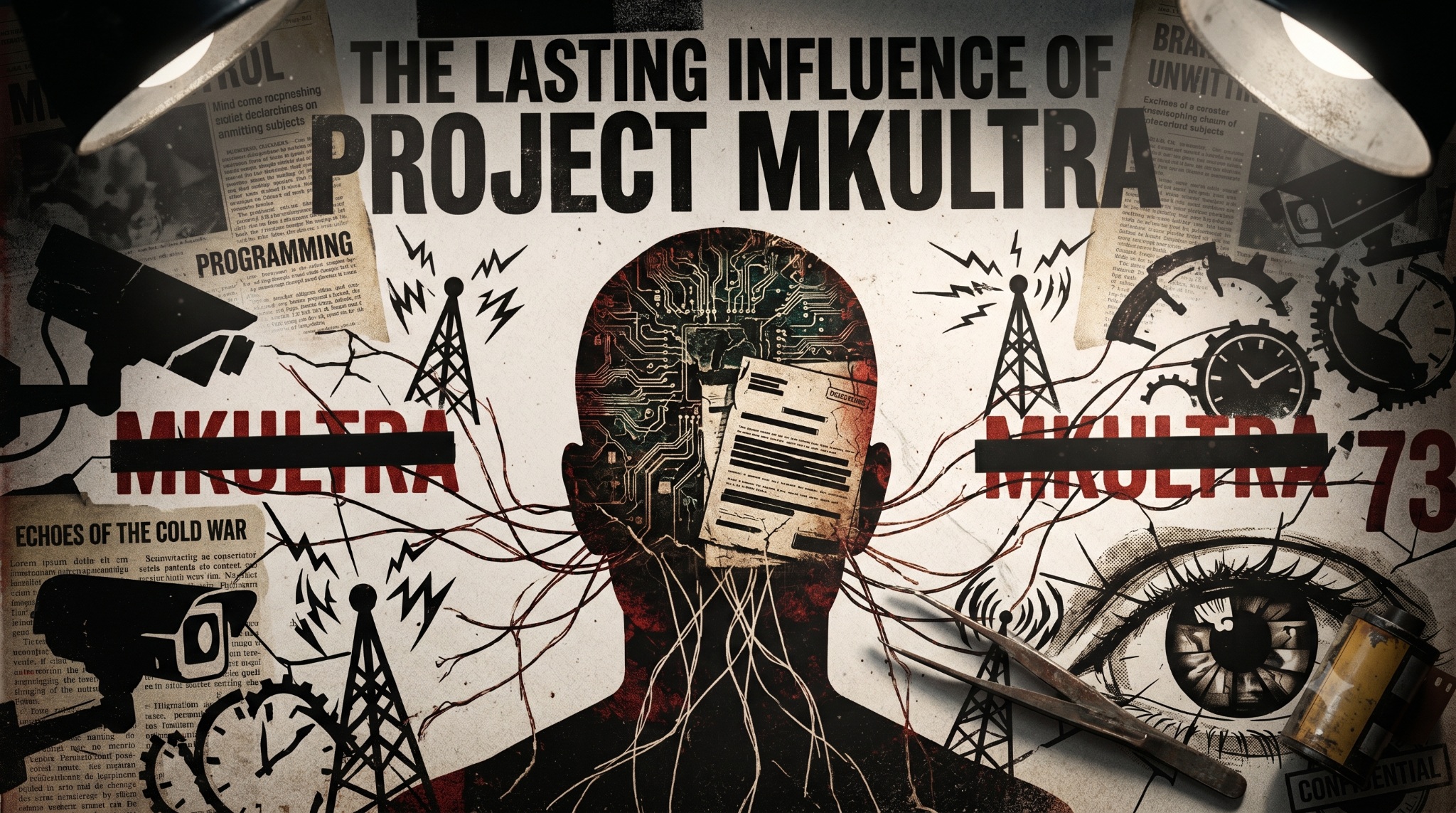
In 1977, a CIA director sat before the United States Senate and confirmed that his agency had, for over two decades, conducted covert experiments on unwitting American and Canadian citizens. The experiments involved LSD administered without consent, sensory deprivation, electroconvulsive therapy beyond any therapeutic dose, hypnosis, sexual blackmail, and psychological torture. At least one person died as a direct result. Many others suffered permanent psychological damage.
The program was called MKULTRA.
It was not a conspiracy theory. It was confirmed by declassified government documents, congressional testimony, and a presidential commission. The CIA director who ordered the destruction of most of the program’s files — in direct anticipation of congressional investigation — was never prosecuted.
This is the full story, documented from primary sources.
The Cold War Context
To understand why MKULTRA happened, you have to understand the specific paranoia of the early Cold War.
By the late 1940s, American intelligence had become convinced that the Soviet Union and China had developed techniques for “mind control” — methods of breaking down an individual’s will and implanting beliefs, confessions, or behaviors through psychological and pharmaceutical means.
This conviction was not entirely irrational. The show trials of the Stalinist era had produced astonishing confessions from high-ranking Soviet officials who had clearly been psychologically broken. American POWs returning from the Korean War showed signs of what was then called “brainwashing.” Cardinal József Mindszenty of Hungary had appeared at his 1949 show trial in a visibly altered mental state, making confessions that seemed impossibly self-incriminating.
The CIA’s concern was specific: if an enemy could control the minds of American officials, agents, or prisoners of war — extracting information, implanting false beliefs, or producing false confessions — the consequences for national security could be catastrophic.
The response was to develop the same capability first.
The Predecessor Programs
MKULTRA did not emerge from nothing. It was the culmination of a series of earlier programs that established both the institutional appetite and the operational methods.
Project ARTICHOKE (1951-1953)
ARTICHOKE was the direct predecessor to MKULTRA, run by the CIA’s Office of Security. Its stated goal was to determine whether it was possible to “make a man do things against his will” through hypnosis, drugs, or other means.
ARTICHOKE experiments involved morphine addiction and withdrawal, hypnosis combined with drug administration, and interrogation under chemical influence. The program operated on prisoners, suspected double agents, and foreign nationals in locations that included Europe and Japan.
A 1952 ARTICHOKE document — declassified decades later — asked whether it was possible to “get control of an individual to the point where he will do our bidding against his will and even against such fundamental laws of nature such as self-preservation.” The answer the program sought was yes.
Project CHATTER (1947-1953)
Run by the U.S. Navy, CHATTER was focused specifically on identifying “truth drugs” — substances that would make subjects answer questions honestly regardless of their intent to lie. Mescaline and scopolamine were among the substances tested. The program was discontinued in 1953 with inconclusive results.
Operation Paperclip
Relevant background: through Operation Paperclip, the United States had recruited hundreds of Nazi scientists after World War II, some of whom had conducted human experiments in concentration camps. While direct links between Paperclip scientists and MKULTRA are not fully documented in declassified material, the institutional context — that American intelligence was willing to exploit the knowledge derived from Nazi human experimentation — is documented.
MKULTRA: Origins and Authorization
MKULTRA was formally authorized on April 13, 1953, by CIA Director Allen Dulles. The program was approved in a memo to the Deputy Director of Plans, Richard Helms — who would later, as CIA Director, order the destruction of most of the program’s records.
The program was placed under the direction of Dr. Sidney Gottlieb, a chemist who headed the CIA’s Technical Services Staff. Gottlieb would run MKULTRA for its entire operational life. He was known within the CIA as “the Black Sorcerer” and “the Dirty Trickster.”
The authorization memo described the program’s purpose as the “research and development of chemical, biological, and radiological materials capable of employment in clandestine operations to control human behavior.”
The program operated under approximately 150 separate research projects (subprojects), contracted out to at least 80 institutions including universities, hospitals, prisons, and pharmaceutical companies. Most of the contractors did not know they were working for the CIA. Many of the subjects did not know they were being experimented upon.
The Subprojects: What Was Actually Done
The scope of MKULTRA research was staggering. The following represents the documented subprojects, drawn from the approximately 20,000 documents that survived the 1973 destruction order.
LSD Experiments
LSD — lysergic acid diethylamide — was the centerpiece of MKULTRA research. The CIA had become aware of LSD’s powerful psychotropic effects in the early 1950s and became convinced it might be usable as a truth serum, a method of inducing temporary psychosis in enemy leaders, or a tool for disorienting and manipulating subjects.
The CIA purchased large quantities of LSD from the Swiss pharmaceutical company Sandoz — which had synthesized the compound and held the patent — and administered it to subjects including:
- Prisoners: Inmates at the Addiction Research Center in Lexington, Kentucky were given LSD for 77 consecutive days. The experiments were conducted without meaningful consent.
- Mental patients: Patients at psychiatric hospitals received LSD without their knowledge, administered by researchers who did not disclose their CIA funding.
- CIA employees: In a program called “Operation Midnight Climax,” CIA operative George White set up safe houses in San Francisco and New York where prostitutes hired by the CIA lured men to apartments equipped with one-way mirrors. The men were given LSD in their drinks without their knowledge while White and CIA observers watched from behind the mirrors. The stated purpose was to study LSD’s effects on “normal” subjects in natural settings.
- Unwitting military personnel: Army and CIA employees were dosed without their knowledge to study reactions.
The most notorious case involved Frank Olson, a U.S. Army biochemist who worked at Fort Detrick, Maryland. In November 1953, Olson attended a CIA retreat at a cabin in rural Maryland. Sidney Gottlieb spiked the group’s drinks with LSD without their knowledge. Olson had a severe adverse psychological reaction. Nine days later, he fell or was pushed from a tenth-floor window of the Hotel Statler in New York City and died. His death was officially ruled a suicide.
In 1994, Olson’s body was exhumed at the request of his family. A forensic examination by Dr. James Starrs of George Washington University found evidence of blunt force trauma to Olson’s skull inconsistent with a fall — suggesting he may have been struck before going through the window. The case was reinvestigated but no charges were filed. The New York District Attorney’s office concluded in 1996 that the evidence was insufficient for prosecution.
The CIA paid Olson’s family $750,000 in 1976 — 23 years after his death — following the public disclosure of MKULTRA.
Hypnosis and Psychological Manipulation
Multiple MKULTRA subprojects investigated hypnosis as a tool for:
- Creating “Manchurian Candidate” style programmed assassins who would carry out killings with no conscious memory of doing so
- Inducing amnesia in agents to prevent them from revealing information under interrogation
- Implanting false memories
- Producing “dissociated states” that could be exploited for intelligence purposes
Declassified documents show the CIA conducted experiments in post-hypnotic suggestion, testing whether subjects could be made to perform actions — including potentially violent ones — while in hypnotic states. The documents confirm these experiments occurred but do not provide clear evidence that a fully functional “programmed assassin” was ever successfully created.
Sensory Deprivation
The CIA funded Dr. Donald Ewen Cameron at McGill University in Montreal, Canada — through a front organization called the Society for the Investigation of Human Ecology — for experiments that went far beyond any legitimate research.
Cameron’s program — which he called “psychic driving” and “depatterning” — involved:
- Prolonged sleep: Patients were kept sedated for weeks or months at a time, sometimes up to 65 days continuously.
- Electroconvulsive therapy at extreme doses: Cameron administered ECT at 30 to 40 times the normal therapeutic intensity, multiple times per day. Standard therapeutic ECT involves a single session; Cameron gave patients up to 360 treatments.
- Sensory deprivation: Patients were placed in sensory deprivation chambers wearing blackout goggles and ear coverings for extended periods.
- Psychic driving: Recorded messages — sometimes the patient’s own voice — were played on loop for 16 to 20 hours a day through a pillow speaker, for weeks at a time.
- Drug combinations: Patients received combinations of LSD, barbiturates, and amphetamines.
Cameron’s stated goal was to “depattern” patients — to completely erase their existing personalities — and then “rebuild” them through programmed messages. The results were catastrophic. Many of his patients, who had come to him with relatively mild conditions such as anxiety and depression, left with severe and permanent psychological damage — including loss of memory covering years of their lives, loss of bladder control, loss of the ability to care for themselves, and regression to infantile states.
Cameron’s patients were not told what was being done to them. They were not told their treatment was funded by the CIA. Many did not know they were being experimented upon at all.
Cameron died in 1967 before the full extent of his work was publicly known. In 1988, nine of his former patients received a settlement of $750,000 from the Canadian government and the CIA, after a class action lawsuit. The settlement included no admission of liability.
Drug Testing on Prisoners
At the Addiction Research Center in Lexington, Kentucky — a federal prison for drug offenders — CIA-funded researchers administered a range of substances to inmates, including:
- LSD in doses up to 150 micrograms daily for extended periods
- Mescaline
- Scopolamine
- Marijuana
- Heroin (in addiction and withdrawal studies)
Prisoners were offered reduced sentences or additional privileges in exchange for participation. The ethical validity of consent obtained under these circumstances is, at minimum, deeply questionable.
Radiation Experiments
Some MKULTRA subprojects overlapped with radiation experiments that were being conducted independently by the Atomic Energy Commission and Department of Defense. Subjects in these cases received radioactive materials without their knowledge or full consent. The full extent of CIA involvement in radiation experiments remains partially classified.
Chemical and Biological Agents
Beyond LSD, MKULTRA investigated numerous other substances including:
- Mescaline: A naturally occurring psychedelic used in earlier programs and continued under MKULTRA
- Scopolamine: An anticholinergic drug used historically as a “truth serum”
- Barbiturates: Combined with other substances in interrogation contexts
- Bulbocapnine: A drug that produces catatonia in high doses
- BZ (3-Quinuclidinyl benzilate): A powerful incapacitating agent that produces delirium and hallucinations, tested under the related program MKNAOMI
The Institutions Involved
One of the most disturbing aspects of MKULTRA is the breadth of institutional involvement. The program’s reach extended across American academic and medical life.
Documented MKULTRA-funded institutions include:
- Universities: Harvard University, Stanford University, Columbia University, University of Illinois, University of Michigan, University of Oklahoma, Johns Hopkins University, University of Rochester
- Hospitals: Massachusetts General Hospital, Mount Sinai Hospital, Stanford Hospital
- Prisons: Federal penitentiaries in Kentucky, California, and New York
- Private research organizations: Multiple front organizations created by the CIA specifically to channel funding
Most researchers at these institutions did not know their funding came from the CIA. The money passed through legitimate-appearing foundations — the Society for the Investigation of Human Ecology, the Josiah Macy Jr. Foundation, the Geschickter Fund for Medical Research — that served as cutouts.
Some researchers knew exactly who they were working for. Others were entirely unaware. The line between knowing and unknowing participation has been contested in every subsequent legal and historical examination of the program.
The Destruction of Evidence
In January 1973, CIA Director Richard Helms — the same Richard Helms who had approved MKULTRA’s original authorization as Deputy Director of Plans in 1953 — ordered the destruction of all MKULTRA files.
Helms was preparing to leave the CIA directorship. The Senate Watergate Committee had begun investigating CIA activities. Helms knew that congressional scrutiny was coming.
The destruction order was executed by Sidney Gottlieb personally. Most of the program’s operational files — estimated at the equivalent of a full filing cabinet for each of the 150+ subprojects — were destroyed.
What survived was approximately 20,000 documents that had been misfiled in a financial records building at the CIA’s Rockville, Maryland facility — and therefore missed in the destruction sweep. These documents were discovered in 1977 during a Freedom of Information Act search requested by journalist John Marks.
It was these surviving documents — a fraction of the total — that formed the evidentiary basis for the Senate investigation.
Helms was later prosecuted for lying to Congress — not about MKULTRA, but about CIA activities in Chile. He received a two-year suspended sentence and a $2,000 fine. He never served a day in prison for either offense.
Gottlieb retired to Virginia, where he raised goats and did volunteer hospice work. He was never prosecuted. He died in 1999.
The Congressional Investigation
The public disclosure of MKULTRA came in stages.
The Rockefeller Commission (1975): President Gerald Ford established a commission chaired by Vice President Nelson Rockefeller to investigate CIA domestic activities following the publication of Seymour Hersh’s landmark 1974 New York Times investigation into CIA surveillance of American citizens. The commission’s report touched on MKULTRA but did not investigate it fully.
The Church Committee (1975-1976): The Senate Select Committee to Study Governmental Operations with Respect to Intelligence Activities — commonly called the Church Committee after its chairman, Senator Frank Church — conducted the most thorough congressional investigation of U.S. intelligence activities up to that point. The committee’s investigation of MKULTRA was hampered by the 1973 document destruction but produced significant findings nonetheless.
The 1977 Senate Hearings: Following the 1977 discovery of the surviving MKULTRA documents by journalist John Marks, the Senate Subcommittee on Health and Scientific Research — chaired by Senator Edward Kennedy — held specific hearings on MKULTRA. CIA Director Stansfield Turner testified and confirmed the program’s existence and scope.
At these hearings, Turner stated: “I think it is most regrettable that our intelligence agency ever entered into such a program. I think it is most regrettable that activities of this kind were undertaken and that they were done so in a manner that was illegal.”
No criminal charges were filed against any CIA official for the conduct of MKULTRA experiments.
The Victims and Legal Aftermath
Identifying MKULTRA victims has been profoundly difficult — partly because of the document destruction, partly because many experiments were conducted on people who were never told what had been done to them, and partly because the CIA’s use of intermediary institutions obscured the chain of responsibility.
Known and documented cases:
Frank Olson: As described above — Army biochemist dosed without consent, died under disputed circumstances nine days later. Family received $750,000. Case never prosecuted.
James Stanley: U.S. Army sergeant who was given LSD without his knowledge in 1958 as part of Army chemical warfare testing (related but separate from MKULTRA). He suffered lasting psychological damage including personality changes that destroyed his marriage and career. He sued the government and his case reached the Supreme Court, which ruled in United States v. Stanley (1987) that he could not sue the government under the Feres doctrine (which bars military personnel from suing the government for injuries sustained during service). The decision was 5-4. Justice William Brennan’s dissent stated that the decision “rivaled the most reprehensible acts of state” in American history.
The Canadian patients: Nine former patients of Dr. Ewen Cameron’s at McGill University received a settlement of $750,000 from the CIA and Canadian government in 1988. Additional plaintiffs received further settlements in subsequent litigation. The Canadian government eventually paid out approximately $100,000 to each of 77 identified Cameron patients.
Operation Midnight Climax victims: The men dosed without their knowledge in the San Francisco and New York safe houses were never identified or compensated. The program’s records were destroyed.
What Was Never Found
The 1973 destruction of files means that significant aspects of MKULTRA remain unknown.
We do not know:
- The full list of institutions and researchers involved
- The total number of subjects experimented upon (estimates range from hundreds to thousands)
- Whether any of the program’s more extreme goals — programmed assassins, permanent memory erasure — were achieved
- The full extent of experiments conducted overseas
- What happened to the results of the destroyed subprojects
What we do know — from the surviving 20,000 documents — is enough to establish that the program was real, extensive, and caused serious harm to real people who were given no opportunity to consent.
MKULTRA in Context: Was It Unique?
MKULTRA was not an aberration in the history of American covert research. It existed alongside and overlapped with:
- MKNAOMI: A joint CIA-Army program developing biological weapons and related chemical agents
- MKDELTA: The operational use of MKULTRA-developed techniques in the field
- Project OFTEN/Project CHICKWIT: Later CIA programs investigating occult and parapsychological phenomena as potential intelligence tools
- Army Chemical Corps experiments: Parallel Army programs testing chemical agents on soldiers at Edgewood Arsenal, Maryland — documented separately but with overlapping personnel and methods
- Tuskegee Syphilis Study: The U.S. Public Health Service’s 40-year study deliberately withholding treatment from Black men with syphilis — a parallel example of government-sponsored human experimentation operating simultaneously
This context does not minimize MKULTRA. It expands the frame: MKULTRA was one manifestation of a broader pattern of covert government experimentation that treated certain categories of people — prisoners, mental patients, soldiers, racial minorities — as available for use without consent.
The Legacy
MKULTRA’s legacy is felt in several domains.
Legal reform: The revelations of MKULTRA and related programs contributed directly to the development of modern research ethics regulation in the United States. The National Research Act of 1974 and the resulting Belmont Report (1979) established the foundational principles of informed consent and human subject protection that now govern medical and psychological research.
Intelligence oversight: The Church Committee’s investigations led to the establishment of permanent Senate and House intelligence oversight committees and the Foreign Intelligence Surveillance Act (1978).
Cultural impact: MKULTRA has become one of the most referenced real-world precedents in discussions of government overreach, conspiracy, and covert operations. Its documented reality has given it a unique status — a case where what actually happened is more disturbing than most fictional treatments.
Ongoing classification: As of 2026, portions of the MKULTRA record remain classified. Freedom of Information Act requests continue to produce new documents, though the rate of new significant disclosures has slowed. The full record of what was done will likely never be known.
Key Facts
- Active period: 1953–1973 (officially; predecessor programs from 1947)
- Authorization: CIA Director Allen Dulles, April 13, 1953
- Director: Dr. Sidney Gottlieb, CIA Technical Services Staff
- Subprojects: ~150 documented
- Institutions involved: At least 80, including major universities and hospitals
- Documents destroyed: Majority of operational files, ordered by Richard Helms, January 1973
- Documents surviving: ~20,000 (misfiled, discovered 1977)
- Known deaths: At least 1 confirmed (Frank Olson); additional cases disputed
- Congressional testimony: 1977 Senate hearings; CIA Director Stansfield Turner confirmed program
- Prosecutions: None
Primary Sources and Further Reading
- The Church Committee Final Report (1976) — Intelligence Activities and the Rights of Americans, Book I — available via the National Security Archive
- 1977 Senate Subcommittee Hearings — Project MKULTRA, The CIA’s Program of Research in Behavioral Modification — full transcript available via the U.S. Government Publishing Office
- CIA MKULTRA documents — approximately 20,000 surviving documents available via the National Security Archive and CIA FOIA Reading Room
- Marks, John. The Search for the Manchurian Candidate: The CIA and Mind Control (1979) — the journalist who filed the FOIA request that recovered the surviving documents; essential primary-adjacent source
- Kinzer, Stephen. Poisoner in Chief: Sidney Gottlieb and the CIA Search for Mind Control (2019) — the most comprehensive modern biography of Gottlieb and history of MKULTRA
- Collins, Anne. In the Sleep Room: The Story of the CIA Brainwashing Experiments in Canada (1988) — the Cameron experiments in full
- Albarelli, H.P. A Terrible Mistake: The Murder of Frank Olson and the CIA’s Secret Cold War Experiments (2009) — the most thorough investigation of the Olson case
- United States v. Stanley, 483 U.S. 669 (1987) — Supreme Court decision on Army LSD testing; Justice Brennan’s dissent
- The Belmont Report (1979) — National Commission for the Protection of Human Subjects — the direct regulatory legacy of MKULTRA
MKULTRA is not a conspiracy theory. It is a documented, congressionally confirmed chapter of American history. Watch our full breakdown on the GrimChronicleShow YouTube channel.