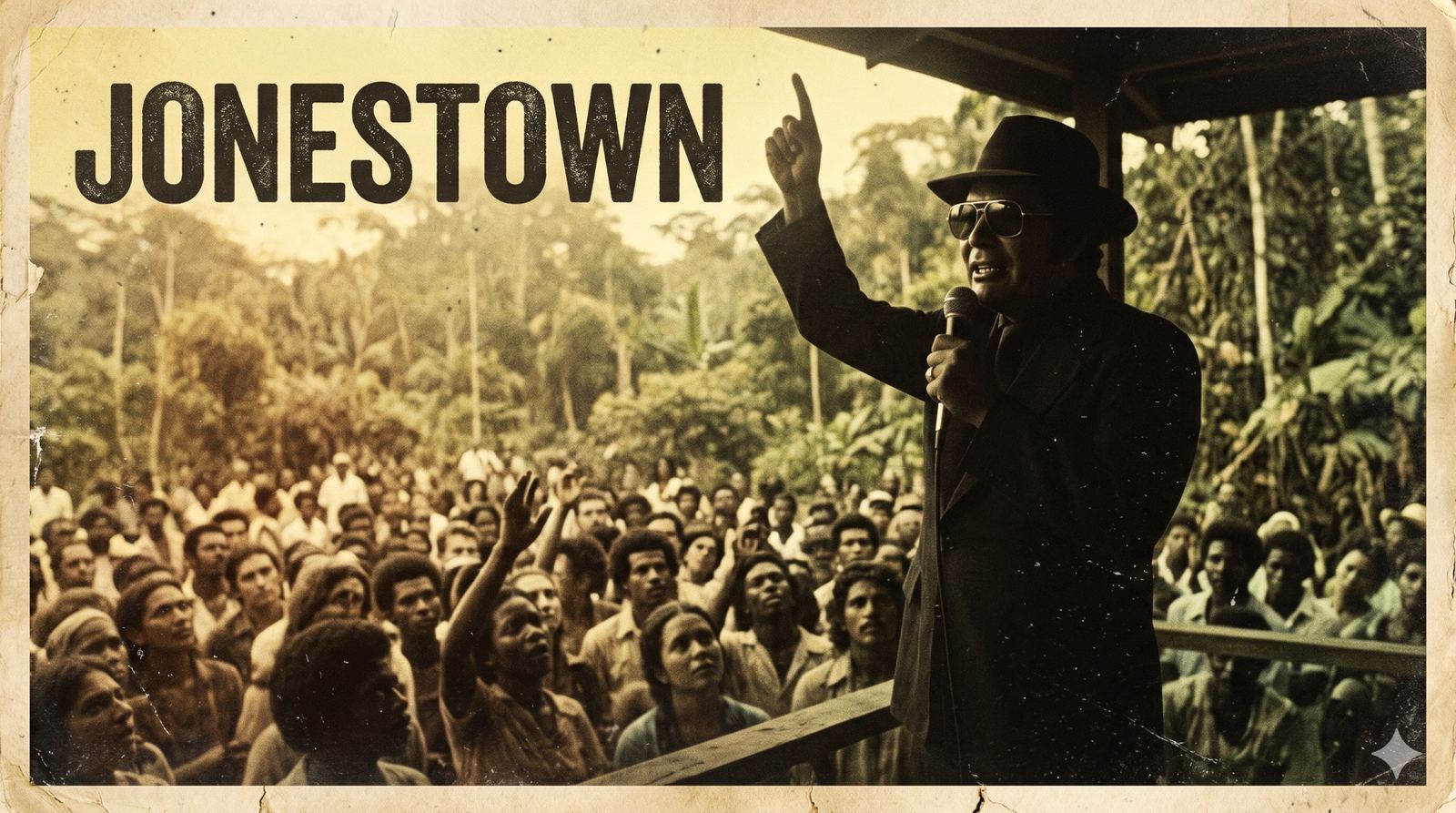
On November 18, 1978, in a remote jungle clearing in the South American nation of Guyana, 918 people died.
Most of them drank cyanide-laced punch willingly. Parents gave it to their children first. Nurses administered it to infants with syringes. People who hesitated were injected by force. A few tried to flee into the jungle and were shot.
It was the largest mass death of American civilians in history — a record that stood until September 11, 2001.
The man responsible was James Warren Jones — a charismatic preacher from Indiana who had built one of the most powerful and politically connected religious organizations in American history. By the time his followers died in the jungle, they had been isolated, psychologically dismantled, and conditioned over years to believe that death was a revolutionary act.
Understanding how it happened requires understanding not just Jim Jones — but the world that made him possible.
Jim Jones: The Making of a Messiah
James Warren Jones was born on May 13, 1931, in Crete, Indiana — a small rural town near the Ohio border. His childhood was unstable. His father, James Thurman Jones, was a disabled World War I veteran with known ties to the Ku Klux Klan. His mother, Lynetta, was an unconventional woman who worked in factories and instilled in her son a sense of exceptionalism and destiny.
Jones was by most accounts a strange child — intensely focused on religion and death from a young age. Neighbors recalled him conducting funerals for animals. He was deeply influenced by a local Pentecostal church and by the oratorical style of the preachers he observed as a boy.
He also observed, from early childhood, the brutality of American racial segregation — and developed what appears to have been a genuine, lifelong hostility to racism. This would become central to his appeal.
Early Ministry
Jones began preaching informally as a teenager and was ordained as a minister in 1952. In 1955, he founded a congregation in Indianapolis that would eventually become the Peoples Temple.
From the beginning, Jones’s church was racially integrated — a radical act in 1950s Indiana. He actively recruited Black members at a time when most white-led churches were explicitly or implicitly segregated. He preached a theology that blended Christianity with socialism, racial justice, and what he called “apostolic socialism.”
He also, from early on, claimed miraculous healing powers. At services, Jones would call out members of the congregation, reveal “divine knowledge” of their personal lives, and claim to cure cancer, blindness, and other ailments. These demonstrations were staged — Jones employed assistants who gathered personal information on congregation members in advance. But they were extraordinarily effective.
The Move to California
In the early 1960s, Jones moved his congregation to Northern California, eventually establishing the Peoples Temple’s main operations in San Francisco and Los Angeles. The timing was perfect.
California in the 1960s and 1970s was a place of profound social upheaval — the civil rights movement, the anti-Vietnam War movement, the counterculture. The Peoples Temple positioned itself at the intersection of all of these. It offered community, purpose, racial integration, and social activism at a moment when millions of Americans were searching for exactly those things.
The church ran drug rehabilitation programs, fed homeless people, provided legal assistance, and organized politically. It cultivated relationships with powerful figures across California politics. At its peak, the Peoples Temple had approximately 20,000 members and was considered one of the most politically influential congregations in California.
Politicians who attended Peoples Temple events in the 1970s included Governor Jerry Brown, Lieutenant Governor Mervyn Dymally, San Francisco Mayor George Moscone, Assemblyman Willie Brown (later Mayor of San Francisco), and Senator Walter Mondale. Jones met with President Jimmy Carter’s wife, Rosalynn Carter, during the 1976 presidential campaign.
The Peoples Temple was not a fringe cult operating in the shadows. It was a mainstream political force.
The Dark Interior
What the public did not see was the interior life of the Peoples Temple — which bore almost no resemblance to its public face.
Inside the church, Jones ran a totalitarian system. Members were required to surrender their assets, their savings, and their salaries to the church. They were required to write “confessional letters” detailing their deepest secrets, sexual history, and any critical thoughts about Jones — letters that were then held as blackmail material. Members who attempted to leave were threatened, surveilled, and in some cases physically beaten.
Jones conducted “catharsis sessions” — public meetings where members were accused of disloyalty and subjected to humiliation, public beatings, and psychological abuse in front of the congregation. These sessions served multiple functions: they reinforced Jones’s absolute authority, they humiliated potential dissenters publicly, and they created shared complicity — members who had witnessed or participated in the abuse of others had reason to remain loyal out of fear of exposure.
Jones was also, by the early 1970s, severely drug-addicted. He was using amphetamines, barbiturates, and other substances in escalating quantities. His behavior became increasingly erratic, paranoid, and grandiose. He claimed to be the reincarnation of Jesus Christ, Buddha, Lenin, and Father Divine simultaneously. He claimed to have supernatural powers including the ability to detect cancer by smell.
His closest aides knew the truth. They maintained the facade publicly while managing his deterioration privately.
The Move to Jonestown
By 1977, the Peoples Temple was under increasing external pressure.
New West Magazine investigation: In August 1977, New West magazine published an explosive investigation into the Peoples Temple, based on accounts from former members. The article described beatings, financial exploitation, blackmail, and psychological abuse. It was the first major public exposé of conditions inside the church.
The “Concerned Relatives” group: Former members and relatives of current members had been organizing since the mid-1970s, gathering testimony and lobbying politicians to investigate the church. They documented specific cases of members being held against their will.
Custody battle: A particularly damaging legal case involved a custody dispute over John Victor Stoen — a child whose guardianship was claimed by both Jones (who claimed to be the boy’s father) and Tim and Grace Stoen, former Temple members who had defected.
Jones responded to this pressure by accelerating a plan he had been developing for years: relocating the Peoples Temple to a remote agricultural commune in Guyana, South America, which he had been calling “Jonestown.”
The choice of Guyana was deliberate. It was a socialist country sympathetic to Jones’s politics. It was remote — the Jonestown settlement was accessible only by small plane or a long boat journey through jungle. It was outside U.S. jurisdiction. And it was, Jones told his followers, a “promised land” where they would build a socialist utopia free from the racism and capitalism of America.
Between 1974 and 1978, approximately 1,000 Peoples Temple members relocated to Jonestown. Most were Black, elderly, or had no resources to go anywhere else. Many had given everything they owned to the church. Jonestown was not a voluntary commune — it was the only option many members had.
Life in Jonestown
The reality of Jonestown bore no resemblance to the promised utopia.
Members worked in the jungle clearing land and growing crops, often 11 hours a day in tropical heat. Food was inadequate — the agricultural program was far less productive than Jones claimed in letters to supporters, and members were frequently malnourished. Medical care was minimal and controlled entirely by Jones.
Jones broadcast his voice continuously through loudspeakers throughout the settlement — at meals, during work, through the night. He delivered rambling, increasingly incoherent monologues about the threats facing Jonestown, the evil of America, the necessity of loyalty, and the concept he called “revolutionary suicide.”
“White Nights”: Periodically, Jones would call the entire settlement together in the middle of the night for what he called “White Nights” — suicide rehearsals. Members were told they were about to be attacked by mercenaries and that they must die with dignity. They were given drinks they were told contained poison. They drank. Then Jones would tell them it was a test.
These rehearsals served a specific psychological function: they habituated members to the idea of communal suicide, made it familiar rather than terrifying, and established the drinking of poison as an act of loyalty and revolutionary commitment.
Jones also controlled all communication with the outside world. Letters were monitored. Members who attempted to send uncensored messages were punished. Passports were confiscated. Armed guards — members Jones called “the angels” — patrolled the perimeter.
Congressman Leo Ryan’s Visit
The event that triggered the final catastrophe was the visit of U.S. Congressman Leo Ryan.
Ryan, a Democratic congressman from California, had received letters from constituents with relatives in Jonestown. He decided to visit personally — an almost unprecedented act. Despite warnings from the State Department and the Peoples Temple, Ryan assembled a delegation that included NBC News journalists, San Francisco Chronicle reporter Ron Javers, and several “Concerned Relatives.”
The delegation arrived in Jonestown on November 17, 1978.
Initially the visit appeared to go well. Jones put on a performance — entertainment, a good meal, smiling members. But during the evening, notes were slipped to NBC reporter Don Harris by members who wanted to leave.
By the following morning, November 18th, a group of approximately 15 members had asked to leave with Ryan’s delegation.
Jones agreed. But as the group prepared to depart, a Temple member named Don Sly attacked Ryan with a knife, cutting his neck — Ryan was not seriously injured. The atmosphere collapsed entirely.
The delegation and the defectors drove to the nearby Port Kaituma airstrip. Two small planes were arranged. As they boarded — a tractor and trailer carrying Jonestown gunmen arrived.
The gunmen opened fire.
Congressman Leo Ryan was shot and killed — the only sitting U.S. congressman to be killed in the line of duty in American history. NBC cameraman Bob Brown was shot while filming, continuing to record until he was killed. Reporter Don Harris was killed. Photographer Greg Robinson was killed. Defecting Temple member Patricia Parks was killed.
Nine others were wounded. Some survivors fled into the surrounding jungle and hid through the night.
The Final Night
Back in Jonestown, Jones called the settlement together.
What followed has been reconstructed from a 44-minute audio recording — known as the “death tape” — made during the final hours. The tape was found by investigators and has been analyzed by researchers for decades. It is one of the most disturbing documents in modern history.
On the tape, Jones tells the community that Ryan’s group will return with soldiers. That Jonestown will be destroyed. That the children will be tortured. He presents death as the only dignified response — as “revolutionary suicide protesting the conditions of an inhumane world.”
A woman named Christine Miller argues back. She suggests they could go to the Soviet Union instead. She asks why they cannot simply live. The crowd shouts her down. Jones responds with controlled urgency, telling her it is too late, that there is no other way.
Nurses began preparing the poison.
The mixture used was Flavor Aid — not Kool-Aid, a persistent misconception that gave rise to the phrase “drinking the Kool-Aid” — laced with cyanide, Valium, Phenergan, and chloral hydrate.
Infants and young children were killed first — syringes of the poison squirted into their mouths by nurses. Parents who resisted were held down. Children who cried were injected against their will.
Adults drank from paper cups. Some willingly. Some with clear reluctance. Those who hesitated were injected by force. Armed guards stood at the perimeter. A few people fled into the jungle.
Jim Jones was found dead with a gunshot wound to the head — almost certainly self-inflicted, though one aide, Annie Moore, was also found shot. Jones’s personal physician, Dr. Lawrence Schacht, administered poison to others and then took it himself.
The entire process took approximately 45 minutes.
The Aftermath
When Guyanese Defense Force soldiers and American officials arrived at Jonestown the following day, they found 909 bodies. Combined with the five killed at the airstrip, the total death toll was 918 — revised to 918 in final counts, though some records cite 909 or 913 depending on the counting methodology.
276 of the dead were children.
The bodies were decomposing rapidly in the tropical heat, making identification and forensic examination extremely difficult. Many victims were initially misidentified or uncounted because they had been lying beneath other bodies — investigators initially announced approximately 400 deaths before the true scale became clear.
Jones’s body was identified by fingerprints. He had $500,000 in cash in a bag beside him.
The Peoples Temple’s bank accounts — held primarily in Panama and Switzerland — contained approximately $10 million. The disposition of these funds remained contested for years.
John Victor Stoen — the child at the center of the custody battle — was among the dead. He was three years old.
The Survivors
Approximately 80-90 Jonestown residents survived — those who were away from the settlement that day, those who fled into the jungle, and a small number who were in Georgetown, Guyana’s capital, on church business.
Among the survivors was Hyacinth Thrash, 76, who slept through the mass death in her cabin and woke to find everyone around her dead. She later wrote a memoir called The Onliest One Alive.
Tim Carter survived by running into the jungle with his brother. His wife and infant son died. He has spent decades speaking publicly about his experiences.
Deborah Layton had defected months earlier and had been desperately trying to warn U.S. authorities about what was happening in Jonestown. Her warnings were not acted upon in time. She later wrote Seductive Poison: A Jonestown Survivor’s Story (1998).
Was It Really “Voluntary”?
This question has been central to how Jonestown is remembered — and the answer is more complex than the phrase “mass suicide” suggests.
The children did not choose to die. 276 people under the age of 18 were killed. Many infants were injected. This was murder.
Adults who resisted were injected by force or held at gunpoint. Guyanese pathologist Dr. Leslie Mootoo, who examined bodies in the immediate aftermath, stated that the needle marks on many victims were in locations inconsistent with self-administration — suggesting forcible injection. He concluded that the majority of deaths were homicides, not suicides.
The psychological conditioning — years of White Nights rehearsals, sleep deprivation, nutritional deprivation, isolation from family and outside information, and sustained psychological manipulation — had so thoroughly dismantled members’ capacity for independent judgment that “voluntary” is a deeply problematic word for what occurred.
The term “revolutionary suicide” was itself a manipulation — a framing Jones had borrowed from Black Panther leader Huey Newton that recast death as a political act of resistance rather than a crime.
The FBI and U.S. government officially classified the deaths as “mass suicide.” Many researchers, survivors, and the families of victims have contested this classification ever since.
The Political and Intelligence Dimensions
Several aspects of the Jonestown case have fueled persistent questions about what U.S. authorities knew and when.
CIA connections: Jonestown was in a strategically sensitive region during the Cold War. The Guyanese government was leftist. Jones had loudly proclaimed his socialist politics and had made overtures to the Soviet Union. Several researchers have noted that the level of U.S. government engagement with the Peoples Temple — and the failure to act on multiple warnings about conditions in Jonestown — is difficult to explain without some degree of deliberate neglect.
The Concerned Relatives’ warnings: Relatives of Jonestown members had been writing to the State Department, the FBI, and congressional offices for years before November 1978, providing specific, credible testimony about members being held against their will. A 1977 State Department report acknowledged concerns but recommended no action.
The missing documents: Significant portions of the government files on Jonestown remain classified or were destroyed. This has fueled conspiracy theories, though the most parsimonious explanation — institutional embarrassment at a massive failure — is probably sufficient.
Why It Matters
Jonestown did not happen because its victims were stupid, weak, or uniquely susceptible to manipulation. It happened because Jim Jones was an extraordinarily skilled manipulator who understood human psychology, exploited genuine idealism, and operated in a social and political context that gave him extraordinary cover.
The people who joined the Peoples Temple were, for the most part, people who wanted to build a better world. They wanted racial justice, community, and purpose. Jones gave them all of those things — genuinely, at first — and used those gifts to create the conditions for total control.
The lessons of Jonestown are not about cults. They are about how power works — how charisma, institutional legitimacy, social isolation, and the slow erosion of individual judgment can make the unthinkable not just possible but inevitable.
Key Facts
- Date: November 18, 1978
- Location: Jonestown, Guyana (near Port Kaituma)
- Total deaths: 918 (909 in Jonestown, 5 at Port Kaituma airstrip, 4 later deaths)
- Children killed: 276
- Congressman killed: Leo Ryan — only sitting U.S. congressman killed in line of duty
- Poison used: Flavor Aid laced with cyanide, Valium, Phenergan, chloral hydrate
- Jim Jones cause of death: Gunshot wound to the head
- Money found: ~$10 million in overseas accounts; $500,000 cash beside Jones’s body
- Audio evidence: 44-minute “death tape” recording of final hours
Sources & Further Reading
- Layton, Deborah. Seductive Poison: A Jonestown Survivor’s Story (1998) — essential first-person account from a survivor who tried to warn authorities
- Reiterman, Tim and Jacobs, John. Raven: The Untold Story of the Rev. Jim Jones and His People (1982) — the most comprehensive journalistic account; Reiterman was wounded at the Port Kaituma airstrip
- Moore, Rebecca. Understanding Jonestown and Peoples Temple (2009) — academic analysis by a scholar whose two sisters died at Jonestown
- Guinn, Jeff. The Road to Jonestown: Jim Jones and Peoples Temple (2017) — the most thorough modern biography of Jones
- Thrash, Hyacinth. The Onliest One Alive (1995) — memoir of the survivor who slept through the mass death
- Alternative Considerations of Jonestown & Peoples Temple (jonestown.sdsu.edu) — the most comprehensive academic archive on the case, maintained by San Diego State University
- FBI Jonestown files — available via FBI Vault (partially declassified)
- The “death tape” (Q042) — transcript and audio available via the Jonestown Institute
- Mootoo, Dr. Leslie — testimony to Guyanese authorities, November 1978 (cited in multiple secondary sources)
The story of Jonestown is one of the most disturbing in modern history — not because it was alien, but because it wasn’t. Watch our full breakdown on the GrimChronicleShow YouTube channel.